

Accessories
Dowel Makers
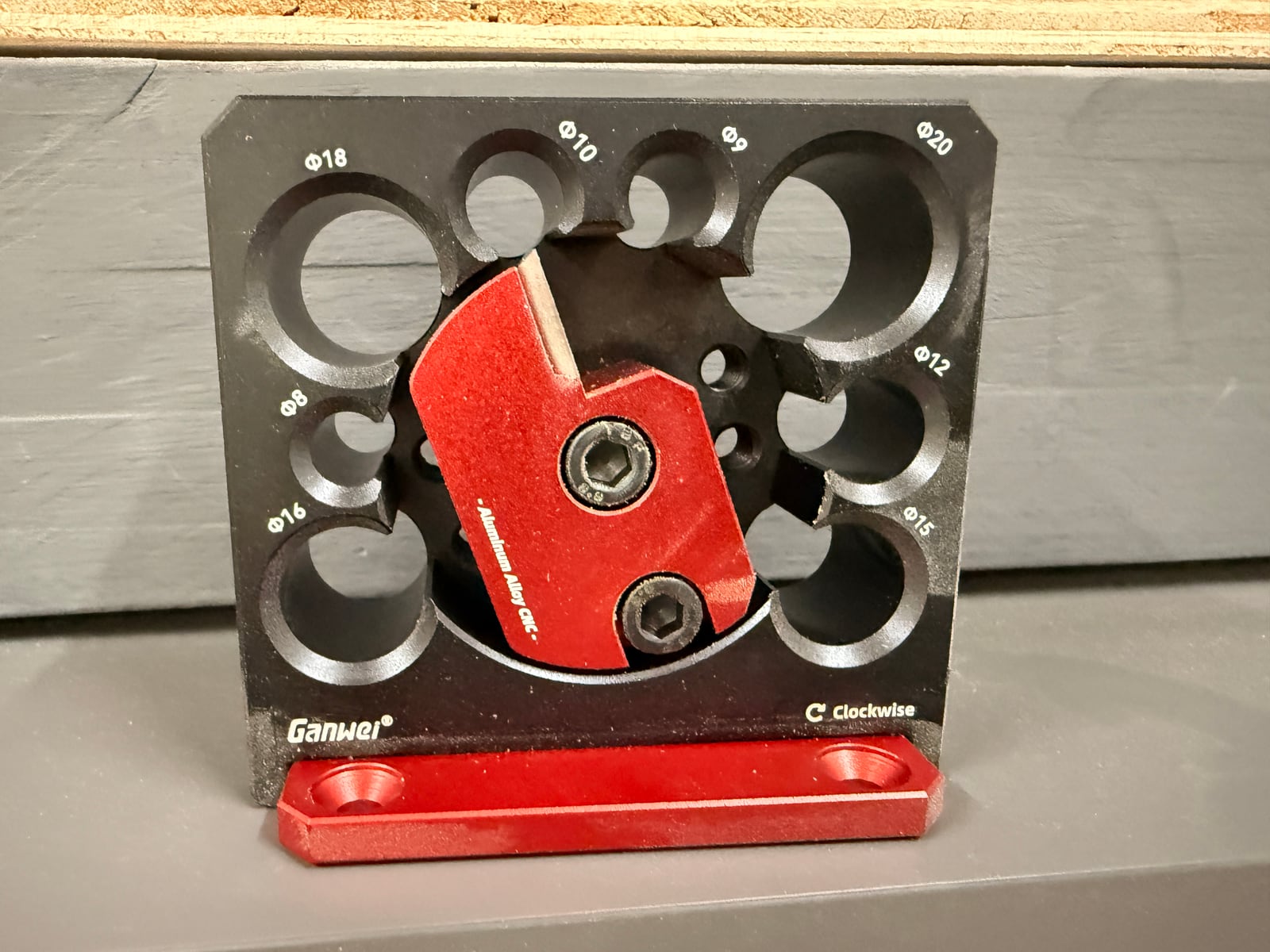
A dowel maker is a hardened plate drilled with a graduated series of sized holes, each with a cutting edge and a relieved pocket to clear shavings. Chuck a roughly-square stick in a drill, drive it through the appropriate hole, and it comes out the other side as a round dowel of that diameter.
The traditional version of this tool is a dowel plate -- just a steel plate with sized holes, driven with a mallet rather than a drill. Same principle, older, and still sold.
Why bother, when dowels cost almost nothing
Because bought dowels are the wrong wood. Dowel stock at a hardware store is birch or beech, whatever the project is. That is invisible inside a joint and extremely visible anywhere a dowel shows -- a through-tenon pin, a drawbored peg, an exposed dowel in a chair. A walnut dowel in a walnut chair looks like the chair; a beech one looks like a repair.
The other reasons:
- Diameter accuracy. Commercial dowel is often undersized, and it varies along its length. A dowel cut through a plate is exactly the hole's diameter for its whole length, which matters when the joint is a press fit.
- Offcuts become useful. The stick you feed in can be a scrap of the same board.
- Species you cannot buy. Nobody sells 10mm padauk dowel.
Using one
- Start close to round. Do not feed a square stick straight into the final size. Knock the corners off first -- a few passes down through progressively smaller holes, or a quick chamfer on a plane -- or you are asking the blade to hog off a lot of material at once and it will tear rather than cut.
- Straight grain only. Runout means the dowel snaps as it forms, or comes out weak. Rive or split the blank if you can rather than sawing it, so the grain follows the stick.
- Drill, not hand pressure. The blade shears best at speed. Grip the far end of the stick in the drill chuck and push.
- Dry wood. Green or damp stock tears and then shrinks out of round afterwards.
- Expect some waste. Not every stick makes it through. Cut more blanks than you need.
Not a doweling jig
Worth being clear, because the names are close and they get confused: a dowel maker produces dowels. A doweling jig drills the holes the dowels go into. They are used in the same joint and are otherwise unrelated tools.
Images
Product: A dowel maker plate, 8mm to 20mm. Each hole has a relieved pocket to clear shavings, and the red block holds the adjustable cutting blade.