

Accessories
Marking Rulers
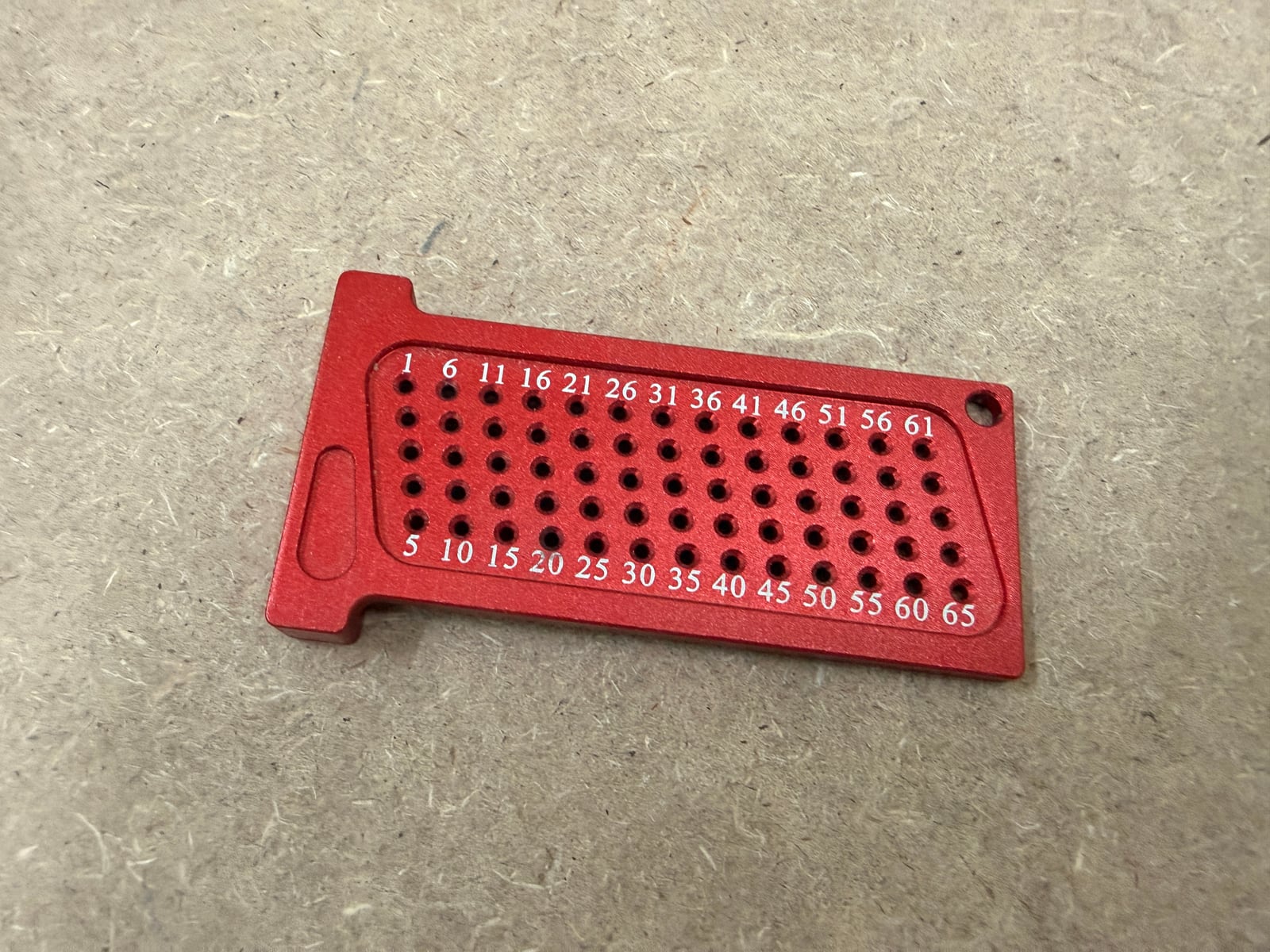
A marking ruler -- also sold as a scribing ruler, a scribe gauge, or a T-type marking ruler -- is a flat plate with a fence at one end and a field of pencil-sized holes through the body. Hook the fence over the edge of a board, drop a pencil point into the hole marked with the distance you want, and slide the whole thing along the edge. The pencil traces a line exactly parallel to that edge, at exactly that offset.
Reading the hole grid
The holes look like a random field until you see the scheme. They run in a diagonal grid, each hole one millimetre further from the fence than the one before, with the columns labelled every five so you can find the number quickly. On the one pictured that is 1mm through 65mm, in single-millimetre steps.
Take a moment with it before the first use: it is easy to count into the wrong row and draw a line four millimetres off, and unlike a mismeasured line there is nothing obviously wrong with the result until it does not fit.
What it replaces
The usual method is to measure in from the edge at two points with a rule, mark, and connect them with a straightedge. That is three chances to be slightly out, and the error shows up as a line that is not quite parallel -- visible on a long board, and invisible until the part is cut.
The ruler makes the offset a reference instead of a measurement. There is nothing to read off a scale and nothing to align.
Where it earns its place
- Ripping to a line on stock too wide, too rough or too irregular for a fence.
- Hinge and hardware layout, where a consistent setback along a whole run of doors is what makes it look deliberate.
- Marking a shoulder parallel to an edge before cutting a rabbet or a groove by hand.
- Following a curved edge. This is the real trick, and no rule and straightedge will do it: keep the fence against a curve and the pencil traces a matching curve at a constant offset. Useful for a live edge, a template, or any bandsawn shape you need to offset.
Against a traditional marking gauge
A marking gauge does the same fence-and-offset job with a pin or a cutting wheel on a sliding beam, and it does one thing better: it cuts a line rather than drawing one. A knifed line is finer than a pencil line, it severs the surface fibres so a chisel or saw can drop into it, and it does not smudge or need sharpening halfway down a board. For joinery layout that is the better tool.
The marking ruler wins on speed and on range. Setting a gauge means loosening, sliding, measuring, locking and test-marking. The ruler is a pencil in a numbered hole. For layout work where a pencil line is what you actually wanted, that is the whole job done in a second.
Most shops end up with both, and use them for different work.
Images
Product: A marking ruler. The T-shaped end is the fence that rides the board edge; the holes are numbered 1 to 65, each one millimetre further out than the last.