

Accessories
Painter's Pyramids
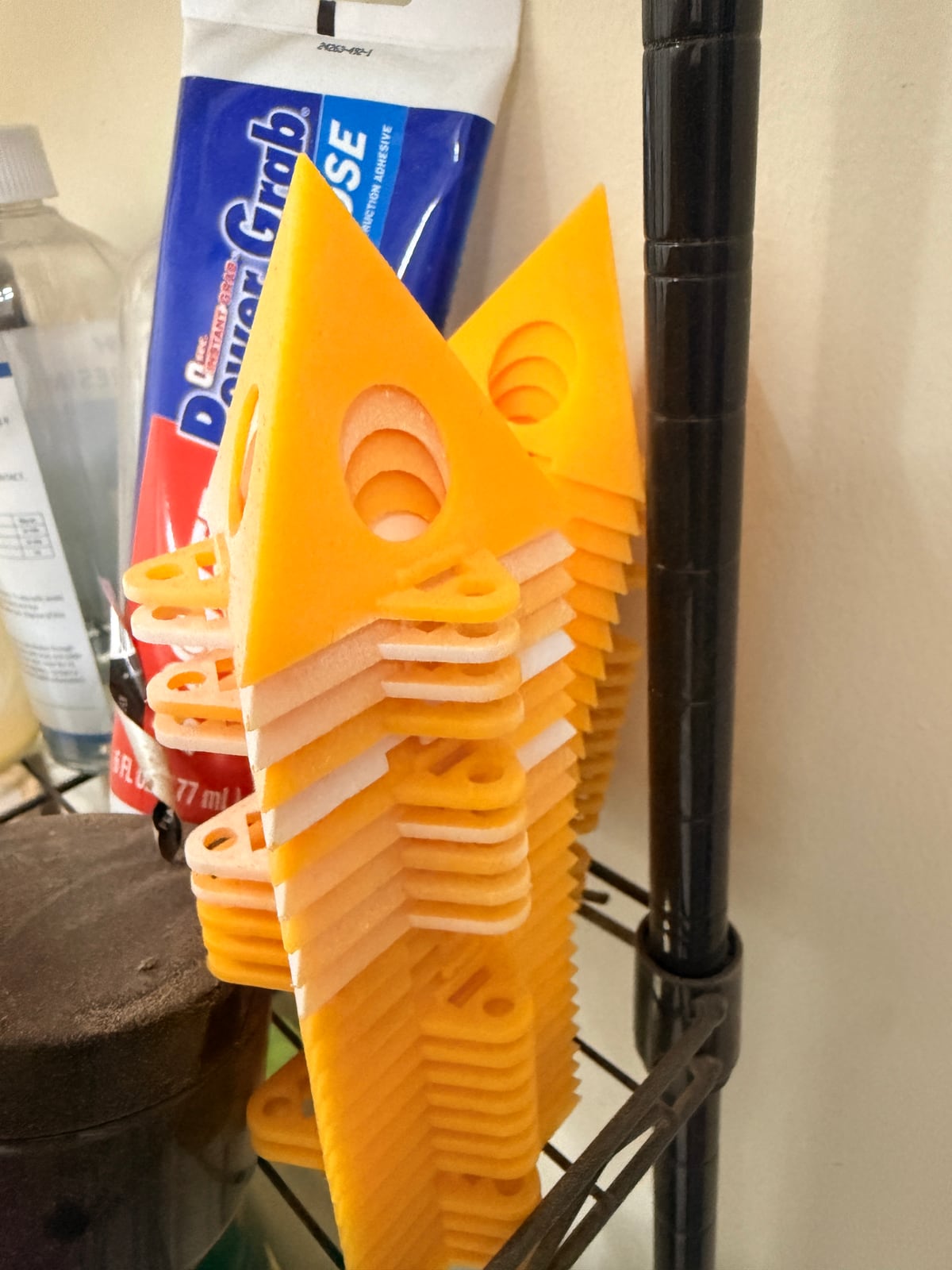
A painter's pyramid is a small moulded plastic triangle with a sharp point standing proud in the middle. The workpiece rests on the points. Contact with the wet finished surface is reduced to a few square millimetres per pyramid.
The problem
Finish a panel lying flat on a bench and two things happen. The finish that runs over the edge pools underneath and dries as a ridge, and the piece bonds to whatever it is resting on. Getting it free afterwards tears the finish off the back edge.
Pyramids reduce the contact to a point. When you lift the piece, the mark left is a pinprick, usually on a face that will not be seen, and it burnishes out with a fingernail or a scuff of abrasive.
Using them
- Four minimum, more for a large or flexible panel -- a piece that sags between supports will sag into contact.
- Put them on the face that shows least, and do the show face last so it never touches anything.
- They stack, both for storage and to gain height.
- Flip and coat the second side once the first is dry to the touch, not fully cured. A fully cured face is fine to rest on; a tacky one will still mark.
- Wipe the points between uses. A blob of cured poly on a point stops it being a point.
They are consumable in practice: they get finish on them, the points eventually blunt, and they cost almost nothing. Buy more than you think you need.
For dry work -- sanding, routing -- work grippers hold far better. Pyramids are specifically for the wet stage, where minimum contact matters more than grip.
Images
Product: A stack of painter's pyramids -- moulded triangles with a sharp raised point at the centre.