

Accessories
Quick-Release Bit Holders
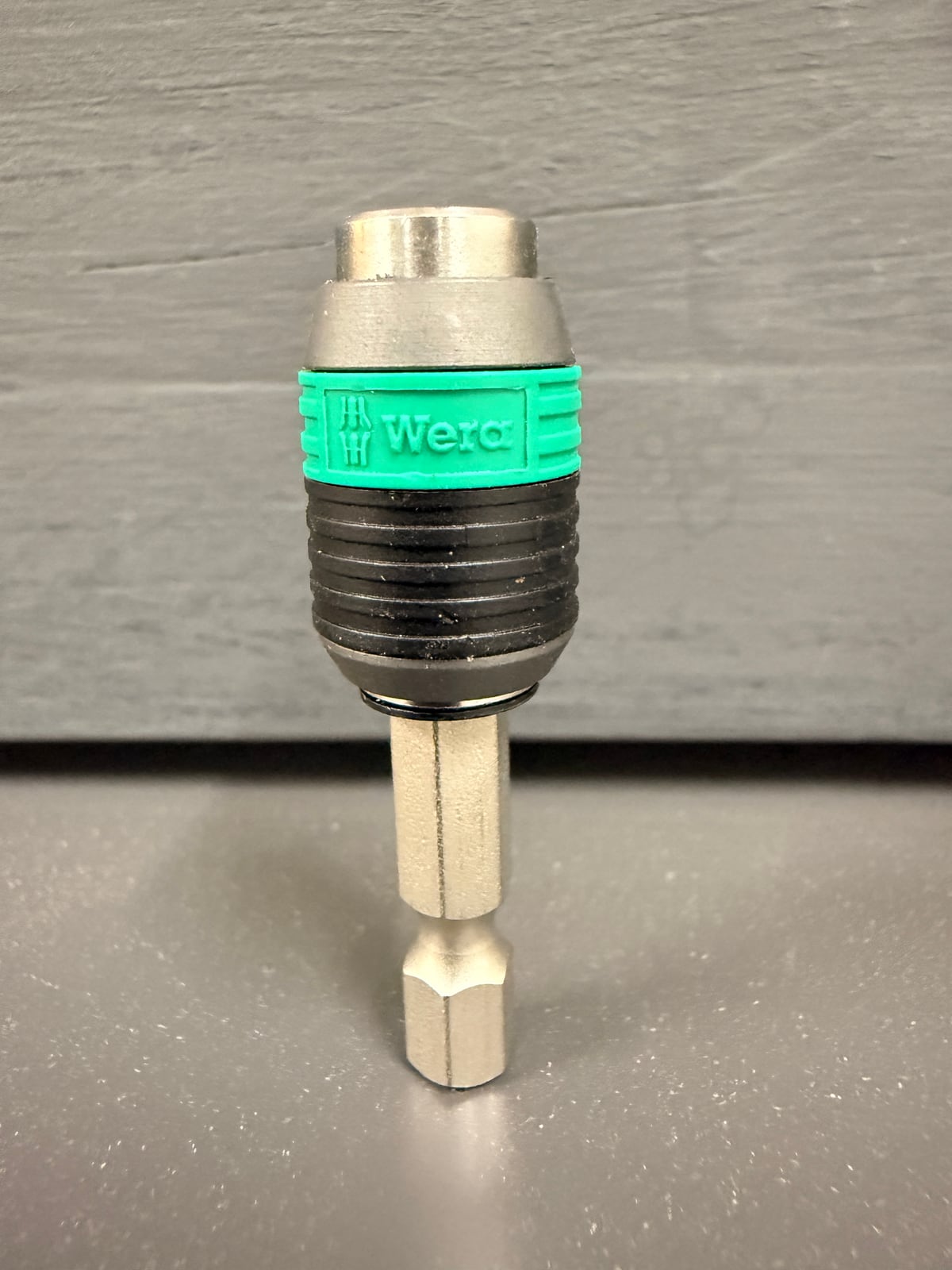
A quick-release bit holder is a short adapter with a 1/4in hex shank at one end and a spring-loaded collar chuck at the other. Bits push in and lock; pull the collar back and they drop out.
It takes hex shanks, and only hex shanks
This is the thing to be clear about before anything else: the collar grips a 1/4in hex shank. That covers driver bits, nut drivers, and any drill or countersink bit specifically sold with a hex shank -- but an ordinary twist or brad point bit has a round shank and will not go in. Round shanks need a three-jaw chuck.
So the appealing "drill a pilot hole, swap, drive the screw, swap back" workflow only exists if you have deliberately bought hex-shank drill bits, or a quick-change countersink like the ones sold for pocket-hole and deck work. With the round-shank bits most people own, the realistic answer is two tools: a drill with a chuck for the holes, an impact driver with a holder for the screws.
What it actually buys you
For driving, speed -- and it compounds over a few hundred screws. Changing a bit in a keyless chuck is a two-handed operation with a bit of grunting; through a quick-release holder it is a one-handed click.
The second benefit is less obvious and matters more for accuracy: a good holder grips the bit concentrically. A three-jaw chuck clamping a hex shank is holding a hexagon in a circle, which centres it only approximately. A wobbling driver bit chews out screw heads and wanders off the mark.
Ordinary holder vs. the ratcheting kind
The basic version is a sleeve and a magnet. The better ones -- Wera's Rapidaptor is the widely copied example -- add two things worth understanding:
- A sleeve you can push against the workpiece to seat the bit fully without touching it, which is genuinely nice when the bit is hot.
- A bearing-mounted outer sleeve that stays still while the bit turns, so you can steady a long bit with a finger without it burning you.
Notes
- Impact rating matters. A holder that is not rated for an impact driver will eventually shear at the hex. Check before you put it in one.
- The magnet collects swarf, which then stops bits seating fully. Wipe it out.
- It adds length, which is occasionally the problem rather than the solution -- in a cabinet, that extra 60mm can be the difference between reaching the screw and not. Keep a stubby option around.
Images
Product: A quick-release bit holder. Pulling the knurled collar back releases the bit; the sleeve holds it magnetically and concentrically.