

Accessories
Router Template Guide Bushings
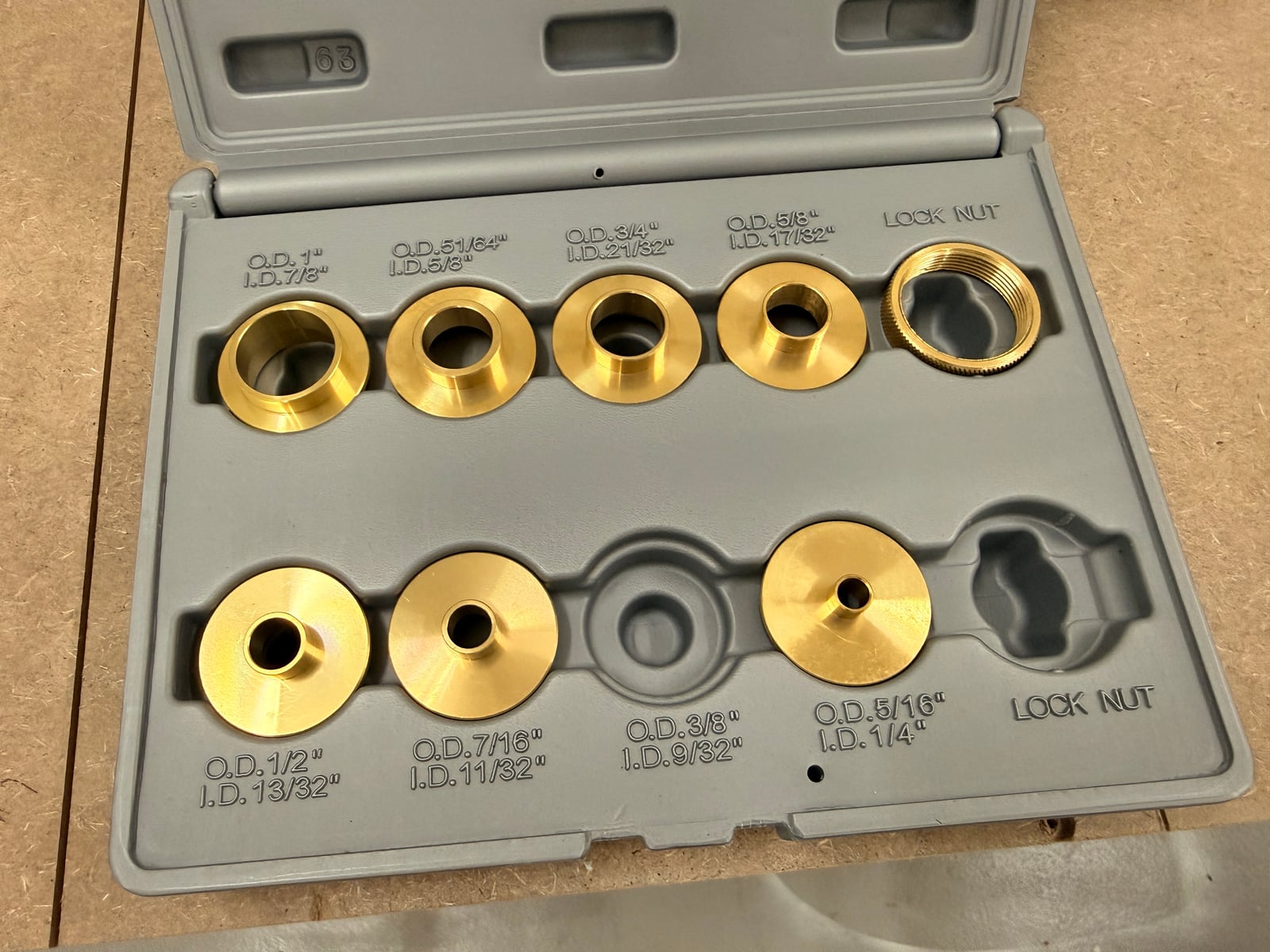
A template guide bushing (also called a guide collar) is a metal sleeve that mounts in the router's baseplate and projects below it. The bit passes down through the middle without touching the sleeve; the sleeve rides against a template. Move the router so the bushing stays in contact and the bit cuts a copy of the template's shape.
Brass is the usual material because it is slippery against a wooden template and it will not damage a bit that touches it.
The offset, which is the whole thing to understand
The bushing is larger than the bit, so the cut is inset from the template by half the difference. With a 1/2in outside-diameter bushing and a 1/4in bit, the offset is (0.500 − 0.250) ÷ 2 = 0.125in. The template has to be made 1/8in oversize in every direction to produce the part you actually want.
Get this wrong and every single cut is out by a consistent, maddening amount. This is why the sets are marked with both O.D. and I.D. on each collar, and why the good move is to write the offset on the template itself when you make it.
Against a bearing-guided bit
A flush trim bit with a bearing does template work with zero offset -- the bearing is the same diameter as the cutter, so the cut matches the template exactly. Simpler, and where possible it is the better answer.
Bushings win in three cases:
- The bit is too small for a bearing, which is most bits under 1/4in.
- The template must sit on top and the bit cannot reach through it -- hinge mortising, inlay work, letter templates.
- Dovetail jigs, essentially all of which are built around a specific bushing and bit combination. Use the one the jig specifies; substituting changes the joint geometry.
Fitting
Bushings thread or clip into the baseplate opening and lock with a nut from above. Two things to check every time: that the bushing is concentric with the collet -- an off-centre bushing puts the offset error on one side only, and a centring cone is worth owning -- and that the lock nut is tight, because a bushing that unscrews mid-cut ruins the workpiece and possibly the bit.
Images
Product: A brass template guide bushing set with lock nuts, each marked with its outside and inside diameter.