

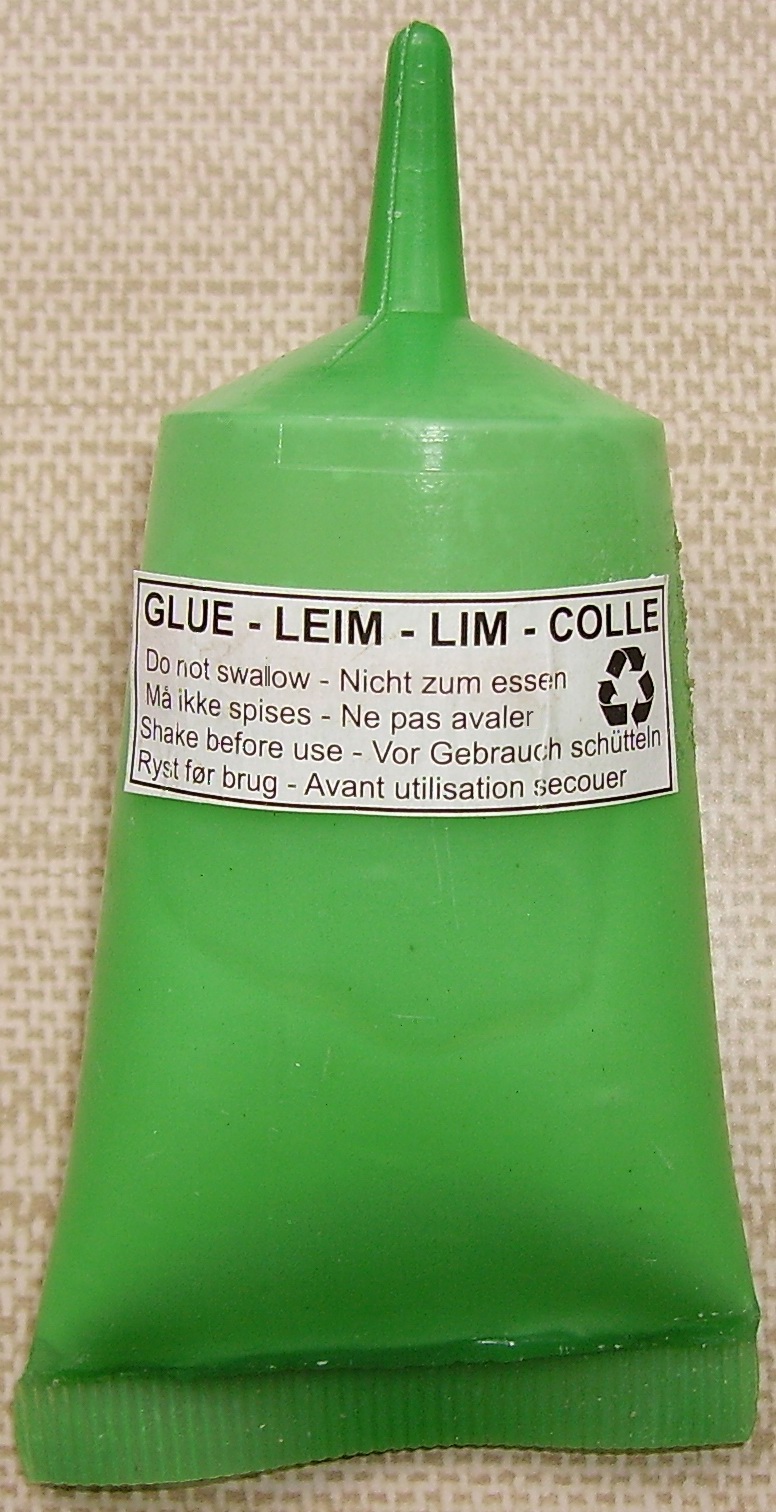
Cjp24, CC BY-SA 3.0, via Wikimedia Commons
Consumables
Wood Glue
Wood glue bonds two wood surfaces by penetrating the fibers and curing into a rigid (or, for some formulations, semi-flexible) film that holds the joint together — done correctly, on a well-fitted joint, the resulting bond is often stronger than the wood fibers surrounding it, which is why properly glued furniture tends to break somewhere other than the glue line if it ever breaks at all.
The common types
- PVA (yellow/white glue) — the standard, default woodworking glue for interior work. Yellow (aliphatic resin) glue is the common furniture-shop choice: strong, sands cleanly once cured, and has a working (open) time long enough for most glue-ups without being so long that clamping takes forever.
- Polyurethane glue — waterproof and gap-filling, expands slightly as it cures (which requires clamping to control), and bonds dissimilar materials (wood to metal, for instance) better than PVA. More finicky to work with and messier when it expands beyond the joint line.
- Epoxy — the strongest gap-filling option, waterproof, and doesn't rely on wood absorbing moisture from the glue to cure (unlike PVA and polyurethane), which makes it the choice for joints with imperfect fit or for bonding non-porous materials. Costs more and typically has a longer, more deliberate cure schedule.
- Hide glue — traditional, reversible with heat and moisture (useful for antique repair and reproduction work), and still preferred by some for its long open time and rub-joint capability. A niche choice for most modern furniture work, but not obsolete.
Why joint fit matters more than glue choice
Glue is not a gap-filler for a poorly fitted joint (with the partial exception of epoxy) — it's a thin-film bond that performs best when two surfaces are already in close, even contact and the glue is just filling the microscopic gaps between fibers. A loose, gappy joint glued with PVA will be measurably weaker than a snug one, regardless of how much glue goes in.
Open time, clamp time, and cure time
These are three different numbers and worth not confusing: open time is how long you have to assemble and adjust before the glue starts to grab; clamp time is how long clamping pressure needs to stay on before the joint can handle careful handling; full cure time (often 24 hours or more) is how long before the joint reaches its full strength and can be put into real service. Rushing past clamp time is a common way a glue-up that looked fine comes apart later.
Squeeze-out
A thin, continuous bead of glue squeezing out along the whole joint line during clamping is actually a good sign — it means enough glue was applied and the joint closed fully. No squeeze-out anywhere along a joint usually means not enough glue was applied in that spot, which is a weaker joint waiting to happen, not a tidier one.
Images
Product: A bottle of wood glue — Cjp24, CC BY-SA 3.0, via Wikimedia Commons
Images are sourced from Wikimedia Commons under their original open licenses -- see each image's caption for its specific license and attribution.