

Woodworking Glossary
Clamp
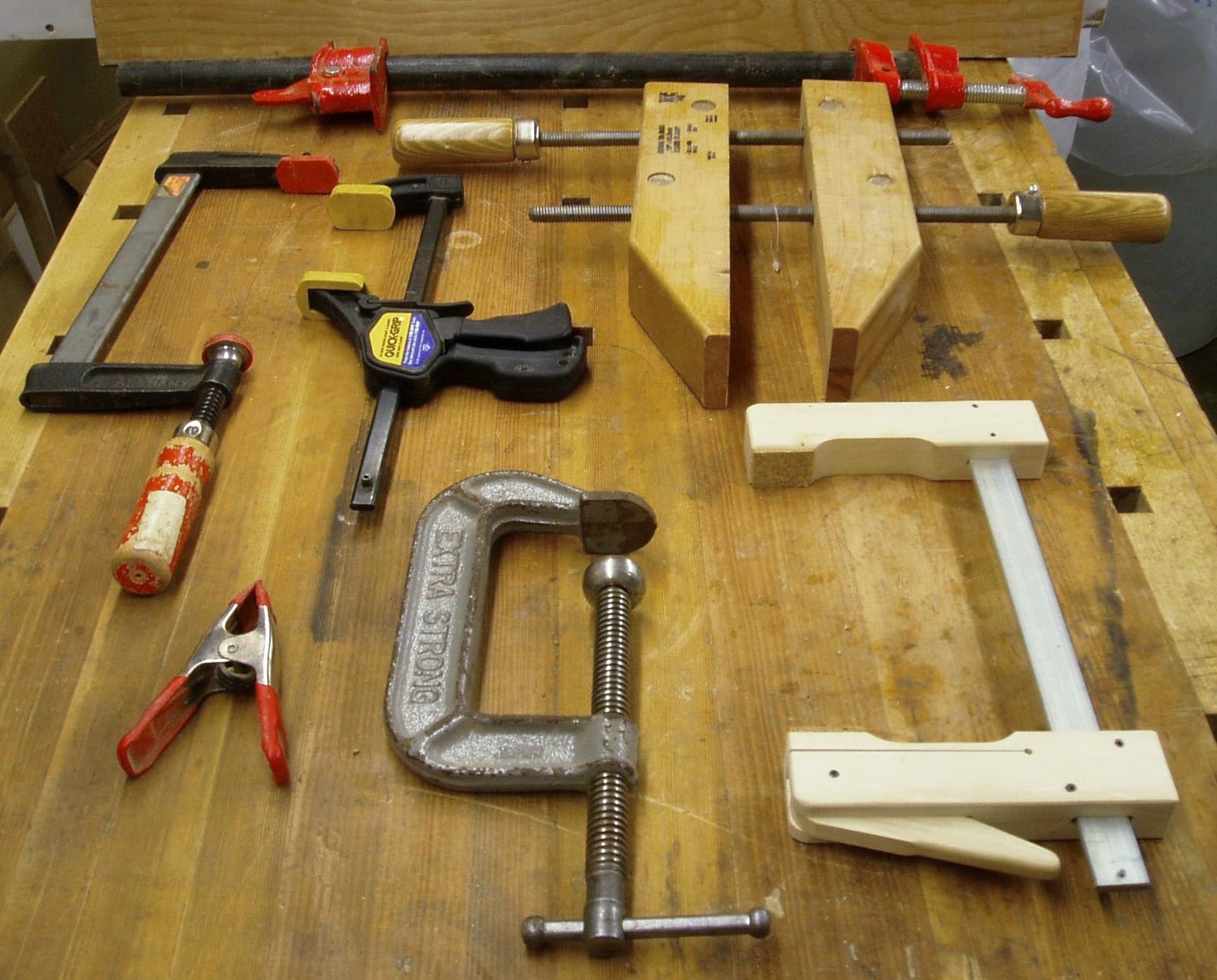
Luigi Zanasi, CC BY-SA 2.0 ca, via Wikimedia Commons
A clamp holds two or more pieces together under pressure -- while glue cures, while a joint is dry-fit and checked, or while a jig is held in place against a workpiece. That single job gets done by a genuinely wide family of mechanisms, each trading off reach, pressure, speed, and cost differently: F-clamps and pipe clamps slide a jaw along a bar for reach; parallel clamps do the same with self-squaring jaw faces; quick clamps trade some of that pressure for one-handed speed; C-clamps and hand screws work in a tighter footprint at higher force.
Most shops end up owning several kinds rather than standardizing on one, because a wide panel glue-up, a small joint, and an oddly-shaped part each genuinely favor a different type -- and because there's rarely such a thing as owning too many clamps.
Images
Product: A glue-up under whatever reached -- C-clamp, F-clamps, a handscrew and a spring clamp. Clamp choice is usually about access, not force. — Luigi Zanasi, CC BY-SA 2.0 ca, via Wikimedia Commons