

Wood Species
African Mahogany (Khaya)
Khaya spp.
- Janka hardness
- 830 lbf
- Specific gravity
- 0.54
- Workability
- Easy to machine, but interlocked grain tears out on quartersawn faces and it fuzzes with dull tooling
When a lumber dealer today says "mahogany" without qualification, this is usually what's in the rack. African mahogany covers several Khaya species from West and Central Africa, and unlike most woods borrowing the mahogany name, it's a legitimate claim — Khaya is in Meliaceae, the same family as genuine Swietenia mahogany, and the resemblance is real.
How it compares to the genuine article
Close, but not identical, and the differences matter:
| Honduran (Swietenia) | African (Khaya) | |
|---|---|---|
| Janka | 900 lbf | 830 lbf |
| Grain | mildly interlocked | strongly interlocked |
| Tearout | minimal | frequent on quartersawn |
| Texture | fine, even | coarser, more open |
| Consistency | very uniform | varies a lot board to board |
| Price | specialty | roughly half |
| CITES | Appendix II | K. senegalensis Appendix II since 2023 |
African mahogany is softer, coarser, and considerably less predictable, with more variation in density and color within a single order. What it gives you in exchange is availability, wide clear boards, and a much friendlier price.
The ribbon stripe
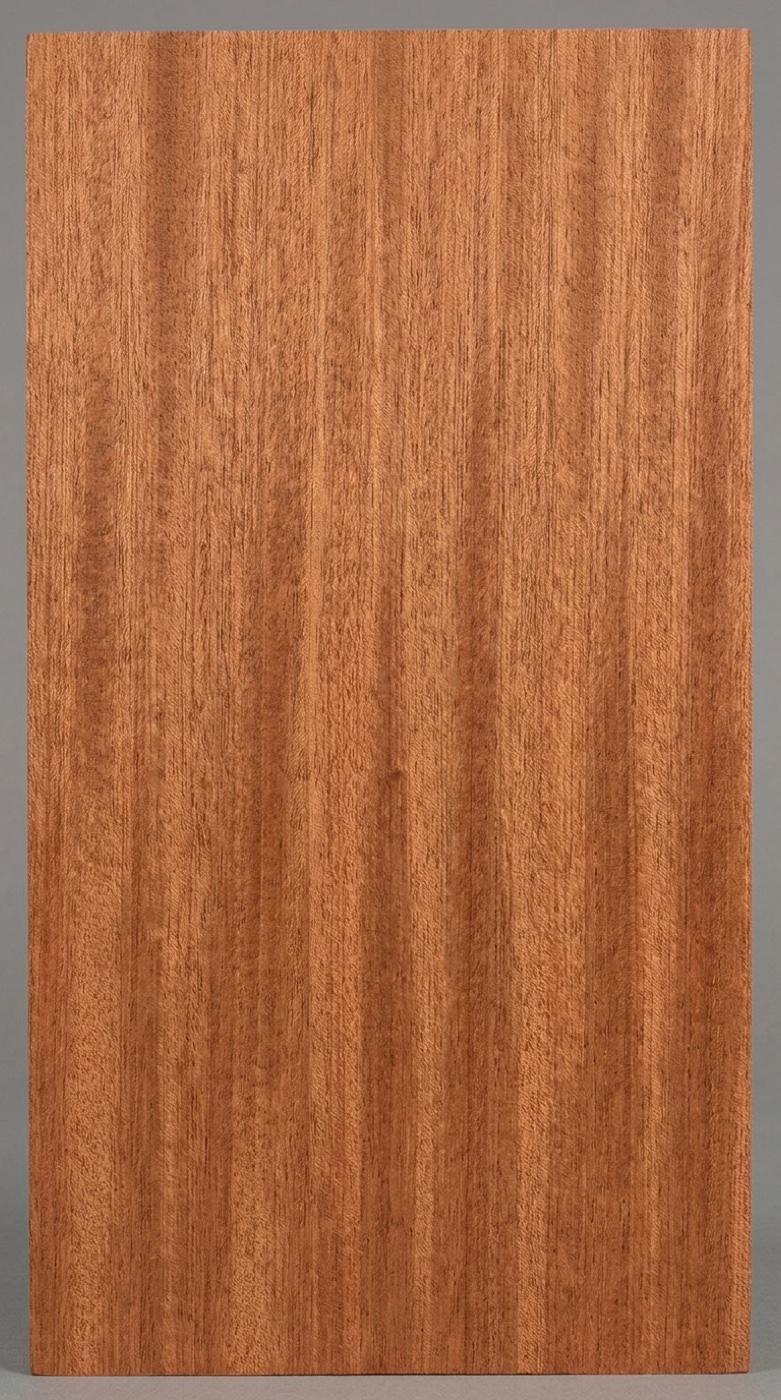
The strongly interlocked grain — fibers reversing direction in alternating layers — produces a striking ribbon or roll figure on quartersawn faces, alternating light and dark bands that shift as you move around the piece. It's genuinely beautiful and it's the main visual reason to choose Khaya deliberately rather than as a substitute.
It's also the reason a hand plane will tear out no matter which direction you push it. Half the fibers are always going the wrong way. Take very light passes with a tightly set high-angle plane, use a card scraper, or feed it through a helical-head machine and accept the sanding.
Working it
- Fuzzes with anything less than sharp tooling, and the fuzz shows under finish.
- Sands well once you're past the fuzz, and takes a good polish.
- Glues and fastens fine.
- Only moderately durable outdoors — better than meranti, well short of teak. It's used for boat building, but with a real finish schedule.
Finishing
Large open pores, so grain filler is the route to a glass-smooth film. It takes stain and dye well, and darkens naturally with UV exposure toward the deeper reddish brown people associate with old mahogany furniture. The Finish Simulator has the prep per finish type.
Typical Uses
Furniture and cabinetry, interior joinery, boat building, musical instruments, veneer, and turned objects.
Images
Raw Wood: A quartersawn board of African mahogany (Khaya) -- the regular ribbon stripe produced by its strongly interlocked grain