
Wood Species
African Padauk
Pterocarpus soyauxii
- Janka hardness
- 1970 lbf
- Specific gravity
- 0.75
- Workability
- Machines and turns beautifully for its density; the dust stains everything it touches bright orange
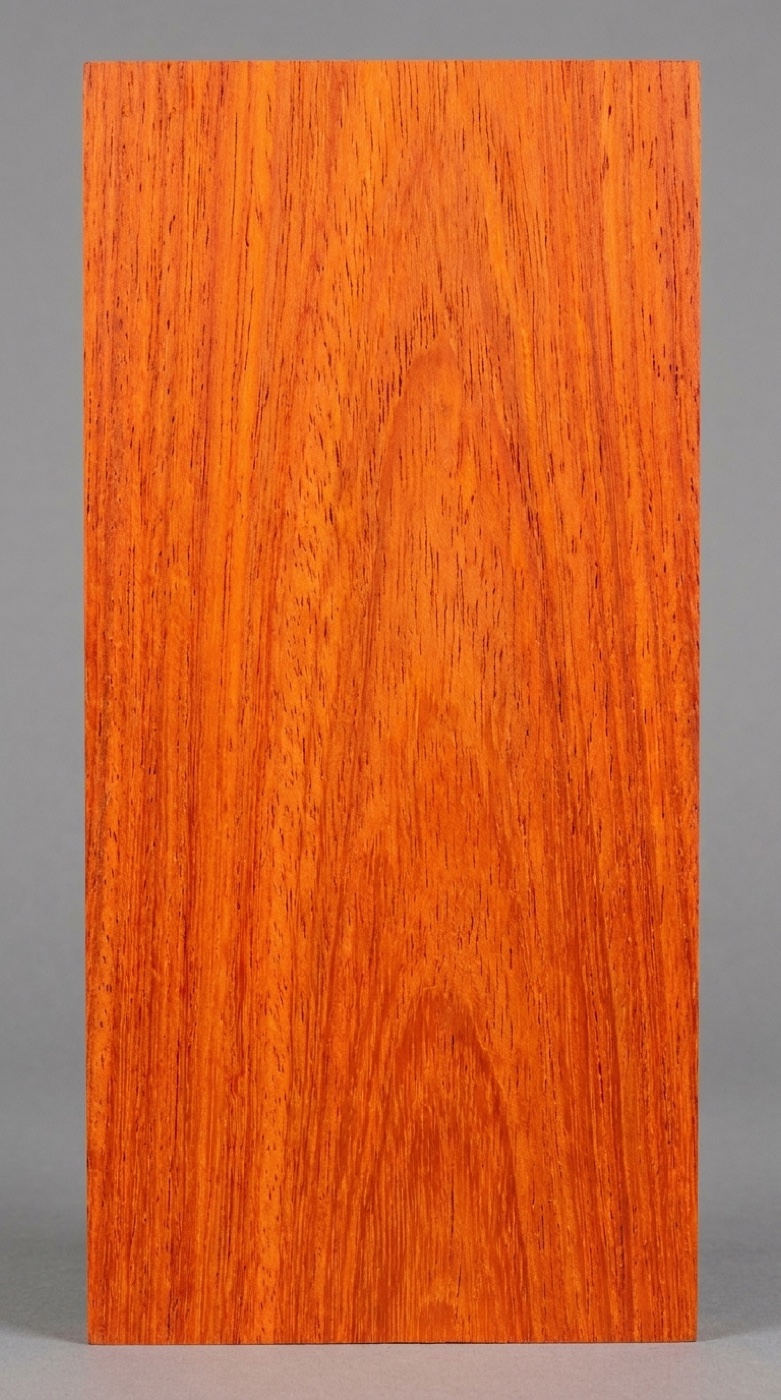
Freshly cut padauk is a colour that doesn't look like it should occur in a tree: vivid, saturated, almost fluorescent orange-red. It is the single most common accent wood in cutting boards, segmented turnings, and inlay work for exactly that reason, and it's cheap enough and available enough to use freely.
Read this before you build with it
Padauk turns brown. Not maybe, not slowly — reliably, within months, to a medium reddish brown and eventually to a dark purplish brown not far off walnut. UV exposure drives it, so a piece sitting in a sunny room changes noticeably in weeks.
Nothing stops this. A UV-inhibiting finish slows it. Keeping the piece out of direct light slows it. Nothing prevents it. The endless forum threads about preserving padauk's colour all end the same way.
The correct approach is to design for the aged colour and treat the orange as a temporary bonus. If you're making a cutting board with padauk stripes, understand that in two years it will read as a brown board with slightly redder stripes. That's still a nice board. It just isn't the one in the photo you took on day one.
Working it
Padauk is unusually pleasant for something at 1,970 lbf:
- Machines and turns cleanly with minimal tearout despite mild interlocking, and takes a superb polish straight off the tool.
- Coarse and open-pored — it will not go glass-smooth without grain filler, and end grain drinks finish.
- Very stable once dry, with low movement.
- Rot resistant and used for exterior work in its native range.
- Glues well, better than most oily tropicals.
The dust
Padauk dust is bright orange and it goes everywhere. It will tint your shop vacuum, your clothes, your hands, and — most annoyingly — any light-coloured wood in the same glue-up. Cutting a maple-and-padauk board and then sanding it can drive orange dust into the maple's pores permanently. Sand light woods first, blow everything down between species, and don't wet-sand a mixed board.
It's also a known sensitizer: padauk dust causes skin and respiratory irritation in a meaningful fraction of people who work it regularly. Respirator on.
Finishing
Open pores want filler for a film finish. Oils deepen the colour considerably and, unfortunately, accelerate the visual shift toward brown. A UV-blocking finish is the best available mitigation. See the Finish Simulator for the prep by finish type.
Typical Uses
Cutting boards and kitchenware, turned objects, inlay and accent strips, musical instruments, knife handles, furniture, and — in West Africa — exterior construction and boat building.
Images
Raw Wood: A board of African padauk -- the intense fresh-cut orange, which will darken to reddish brown within months