

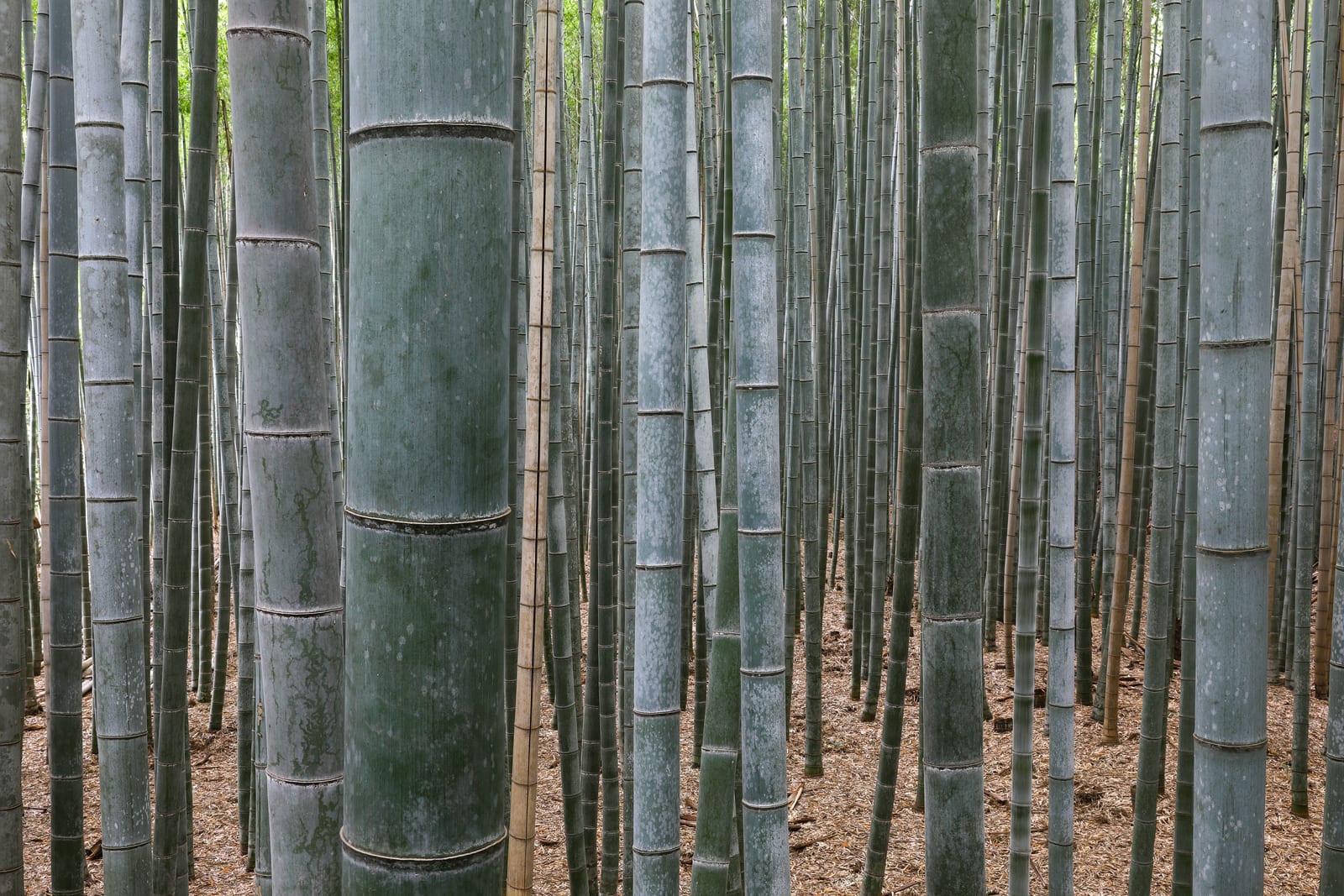
Basile Morin, CC BY-SA 4.0, via Wikimedia Commons
Wood Species
Bamboo
Bambusoideae (various genera, commonly Phyllostachys)
- Janka hardness
- 1650 lbf
- Specific gravity
- 0.65
- Workability
- Good — machines similarly to a hardwood despite being a grass; can dull blades due to silica
Bamboo isn't wood at all in the botanical sense — it's a fast-growing grass — but it's included in every Janka hardness chart because bamboo flooring competes directly with hardwood flooring on durability and price.
Hardness Varies Enormously by Processing
Here's the single fact worth remembering about bamboo hardness: solid, natural (non-strand-woven) bamboo flooring typically tests in the 1,300-1,700 lbf range — a mid-hard domestic hardwood, roughly. Strand-woven bamboo, where the fibers get shredded, compressed, and fused under heat and resin, is a genuinely different product, commonly testing at 3,000-4,000+ lbf — more than double what oak manages. Check which one you're actually looking at before you compare numbers, or you'll draw the wrong conclusion entirely.
Working Properties
Natural bamboo machines about like a moderately hard domestic hardwood, silica content included, which means it'll dull blades a bit faster than the number alone implies. Strand-woven bamboo is denser and rougher on tools across the board.
Typical Uses
Flooring almost exclusively, plus some cutting boards and small furniture pieces.
Images
Tree: Bamboo Forest, Arashiyama, Kyoto, Japan. Focus stacking from 6 pictures (long exposure photography). — Basile Morin, CC BY-SA 4.0, via Wikimedia Commons
Images are sourced from Wikimedia Commons under their original open licenses -- see each image's caption for its specific license and attribution.