

Wood Species
Basswood
Tilia americana
- Janka hardness
- 410 lbf
- Specific gravity
- 0.37
- Workability
- The easiest wood there is to carve; too soft and fuzzy to machine or sand well
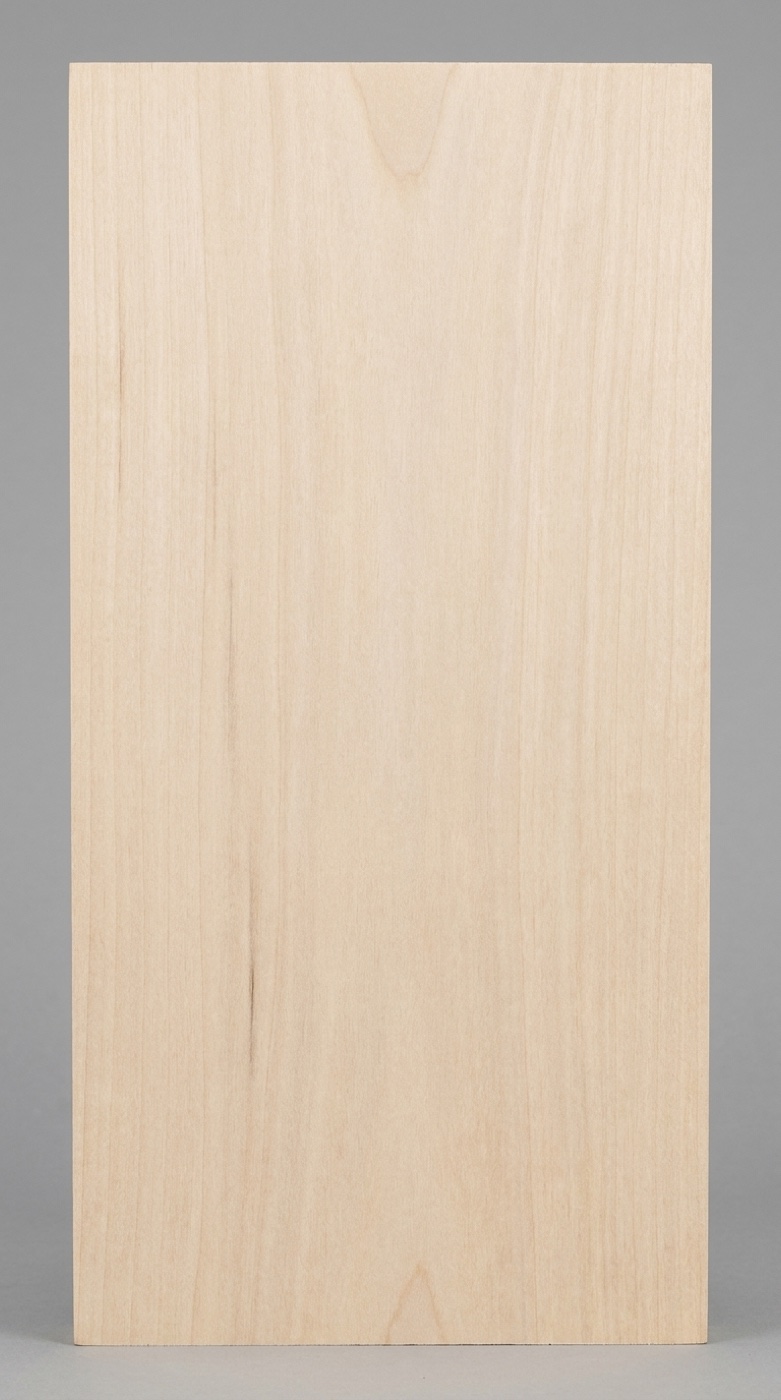
Basswood is what you buy when you want the wood to get out of the way. It is pale, nearly featureless, extremely soft, and completely uniform in texture, with no hard latewood bands, no interlocked grain, and almost no visible figure to fight against. For carving, that combination is close to ideal, and basswood has been the default North American carving wood for as long as anyone has been selling carving blanks.
What "no grain to fight" actually means
Most woods have direction. Cut one way and the tool slices cleanly; cut the other and it tears. The harder the density swing between growth rings, the more the wood steers your tool for you.
Basswood has almost none of that. It cuts nearly as easily across the grain as with it, which means a sharp gouge goes where you aim it rather than where the wood prefers. That's why relief carvers, chip carvers, and whittlers use it, why it's the standard for architectural models and pattern work, and why it shows up as the core in a lot of guitar bodies and window blinds.
The catch is that "sharp" is doing real work in that sentence. Basswood's soft fibers compress rather than cut under a dull edge, leaving a crushed, fuzzy surface. It rewards sharpening more than almost any other wood, and punishes skipping it more too.
What it's bad at
Nearly everything else. At 410 lbf it's softer than eastern white pine. It's weak, it dents from handling, it doesn't hold a screw well, and it sands poorly — the fuzz just lies down and springs back. It's a bad choice for furniture, a worse one for anything structural, and it will not survive outdoors for a season.
Finishing
Basswood is pale, thirsty, and blotches under pigment stain about as badly as anything on the rack. Carvers frequently leave it bare, paint it with acrylics, or seal it with thinned shellac first. If you want it colored, dye is far more predictable than pigment stain, and a shellac washcoat first is close to mandatory — see the Finish Simulator for the prep.
Typical Uses
Carving of every kind, architectural and industrial models, pattern making, window blinds and shutters, musical instrument bodies, boxes, and picture frames.
Images
Raw Wood: A board of basswood -- pale, even, and nearly featureless, which is exactly what carvers want from it