

Wood Species
Bubinga
Guibourtia spp.
- Janka hardness
- 2410 lbf
- Specific gravity
- 0.87
- Workability
- Dense but well-mannered; interlocked and figured stock tears out badly and silica dulls edges
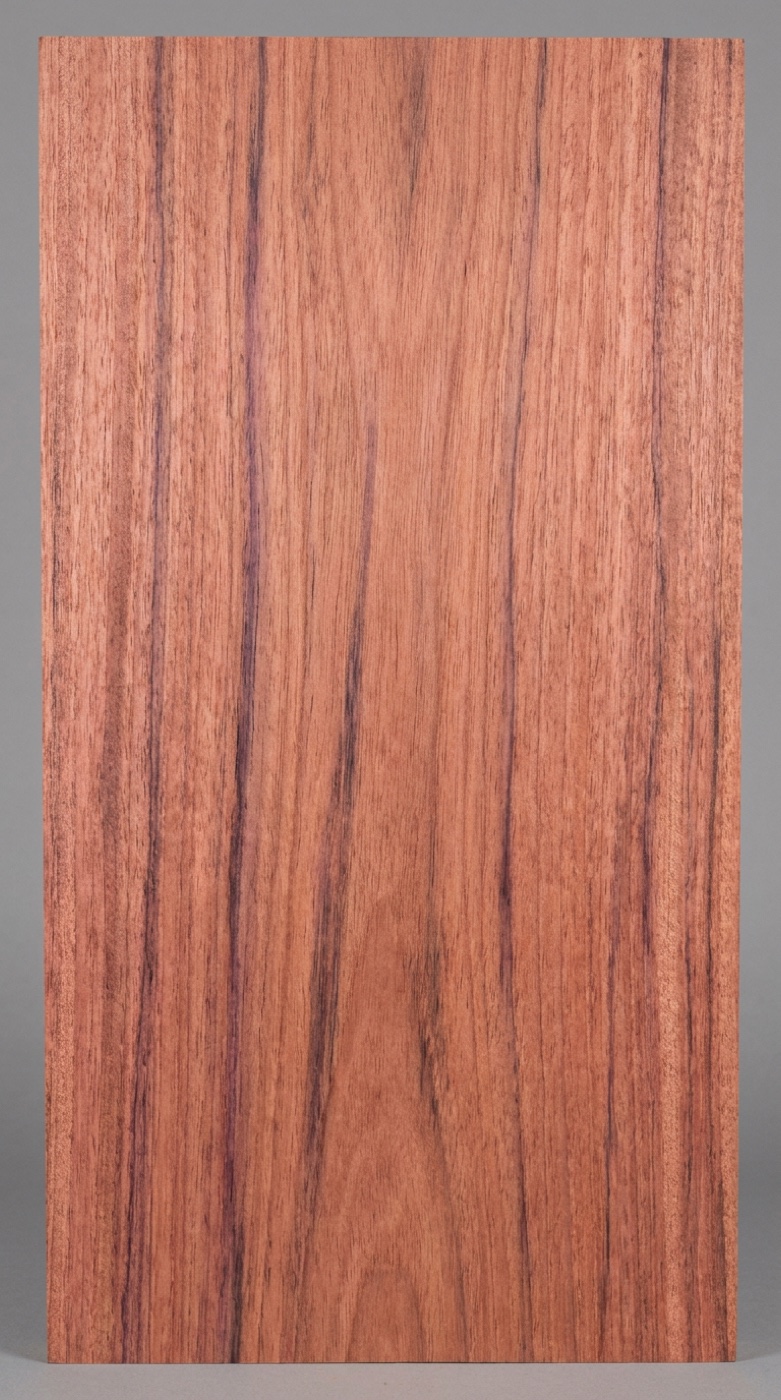
Bubinga covers several Guibourtia species from equatorial Africa, sold as a dense, hard, pinkish-to-reddish brown hardwood with darker purple-black streaking. Its two claims to fame are size and figure.
Why people seek it out
The trees are enormous. Bubinga comes to market in slabs and boards wide enough to make a conference table from a single piece — genuinely rare among quality hardwoods, and the reason it turns up in high-end furniture where a glue line would spoil the effect.
The figure can be extraordinary. Bubinga produces waterfall, pommele, quilted, and flamed figure at a scale and intensity few woods match. Pommele bubinga in particular — a dense field of small overlapping bubbles — is one of the most sought-after decorative veneers in the world, and priced there.
It's also frequently sold as "African rosewood," which it isn't. It's in the same broad legume family but a different genus entirely from Dalbergia.
The CITES situation
Three Guibourtia species — G. demeusei, G. pellegriniana, and G. tessmannii, the main commercial bubingas — were listed on CITES Appendix II in 2017. Trade is legal with permits, but the listing tightened supply and pushed prices up sharply, and it applies to veneer and finished goods as well as lumber.
Practically: buy domestically from a dealer with documented stock, expect specialty pricing, and don't plan on shipping a bubinga piece internationally without doing the paperwork.
Working it
- Dense and hard, 2,410 lbf, and it contains silica, so it dulls edges faster than density alone predicts. Carbide, and expect to sharpen.
- Plain straight-grained bubinga machines well. Figured stock is a different animal — waterfall and pommele figure tears out under any plane and generally has to be scraped or sanded to a finished surface.
- Very stable once dry, with modest movement.
- Turns beautifully and takes a high natural polish.
- Glues reasonably, better than the oilier tropicals, though a wipe with solvent before glue-up doesn't hurt on dense stock.
Finishing
Medium texture with moderately open pores — filler if you want a mirror film finish. It takes oil and film finishes well without the curing problems the oily rosewoods cause, and the colour deepens attractively with age from pink-red toward a darker reddish brown.
Typical Uses
Fine furniture and tabletops, veneer (especially figured), turned objects, musical instruments — drum shells and bass bodies particularly — knife handles, and interior joinery.
Images
Raw Wood: A board of plain-grain bubinga -- pinkish red with darker streaking; the figured grades look nothing like this