

Wood Species
Douglas Fir
Pseudotsuga menziesii
- Janka hardness
- 620 lbf
- Specific gravity
- 0.51
- Workability
- Machines well for a softwood, but the hard latewood bands splinter and tear, and it's rough on edges
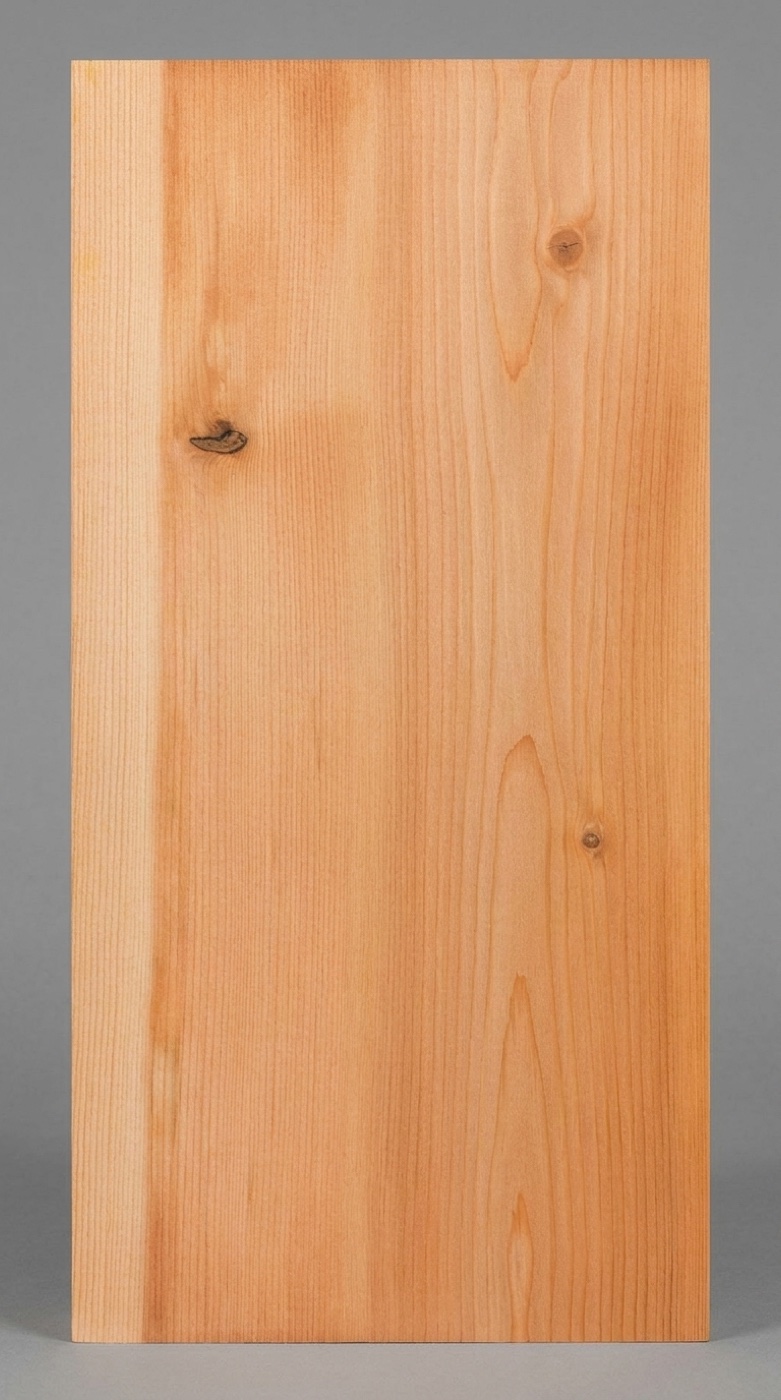
Douglas fir is not a true fir (hence the hyphen purists insist on: Douglas-fir), and it is the dominant structural softwood of western North America. It has an exceptional strength-to-weight ratio and high stiffness, which is why it frames houses, spans as beams and joists, and gets laminated into glulam and veneered into structural plywood.
Why woodworkers care
Three reasons it shows up outside framing:
- Workbench tops. Laminating up a bench top from construction-grade 2x10s or 2x12s is one of the most common first-bench builds going, and Douglas fir is the usual material in the west. It's stiff, heavy enough, dead cheap, and available in wide clear-ish stock. It dents more than a beech or maple top would; most people decide they don't care.
- Timber framing. Big clear Doug fir timbers are the standard for exposed post-and-beam work, and the wood ages to a rich orange-brown that looks superb.
- Old-growth reclaim. Vertical-grain old-growth Douglas fir salvaged from demolished buildings is a genuinely lovely material — dozens of tight growth rings per inch, dimensionally stable, and nothing like the fast-grown stuff at the lumberyard. It's sold at hardwood prices and worth it.
The banding problem
Douglas fir has one of the sharpest earlywood-to-latewood density contrasts of any common softwood — soft pale bands alternating with hard, dark, resinous ones. That produces its handsome striped look and causes its two main headaches:
- It splinters. Those hard bands break away in long slivers rather than crumbling. Handle rough stock with gloves; ease every edge you'll touch.
- It's a bad candidate for stain. The soft bands drink pigment, the hard ones repel it, and the result is aggressively striped. Clear finish or paint. If you must stain, a gel stain over a sealed surface is the only version that behaves — see the Finish Simulator.
It also dulls hand plane irons faster than its density suggests, and tearout around knots is common.
Grades to know
Construction-grade dimensional lumber is dried to around 19% moisture content and will move in a heated shop — sticker it and wait, same as any framing stock. "Clear vertical grain" (CVG) is a different product entirely: quartersawn, knot-free, stable, and priced accordingly.
Typical Uses
Framing, beams and timber framing, structural plywood and veneer, workbench tops, flooring, doors and windows, boat building, and — historically, in enormous quantity — ship masts.
Images
Raw Wood: A board of Douglas fir -- orange-brown with the sharp earlywood/latewood contrast that makes it splinter and makes it stripe under stain