

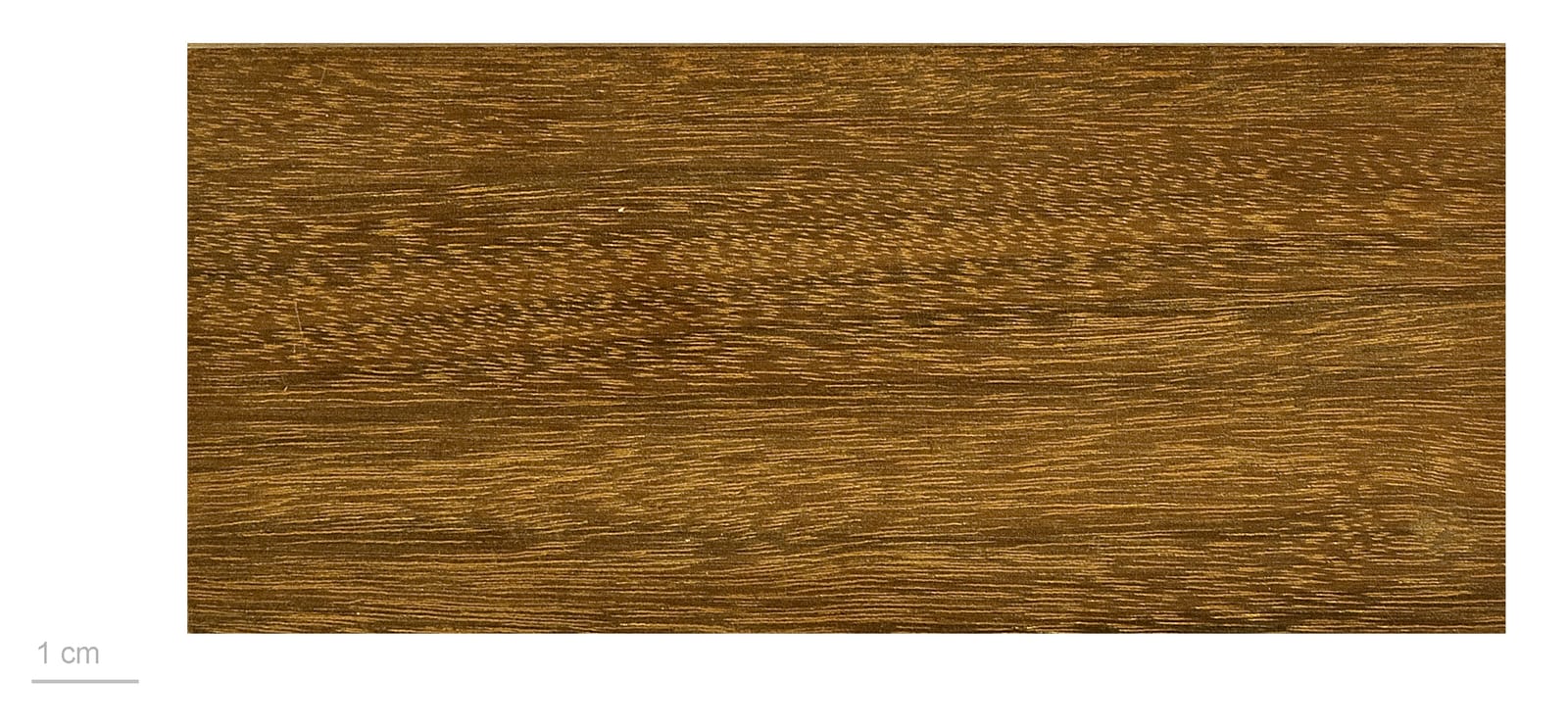
Jean-Pierre Chéreau & Roger Culos, CC BY-SA 3.0, via Wikimedia Commons
Wood Species
Ipe (Brazilian Walnut / Lapacho)
Handroanthus serratifolius (syn. Tabebuia spp.)
- Janka hardness
- 3490 lbf
- Specific gravity
- 0.98
- Workability
- Very difficult — extremely dense, dulls tools quickly, requires pre-drilling and oil removal before gluing
Ipe is sold under enough trade names — most commonly Brazilian Walnut and Lapacho — that all point back to the same species complex (Handroanthus, formerly classified under Tabebuia). Different suppliers and regional sourcing sometimes report noticeably different Janka figures for the supposedly "same" wood; The Wood Database lists 3,490 lbf, while some flooring-industry charts run as high as 3,680-3,684 lbf for "Brazilian Walnut" specifically — likely different grading, different moisture basis, or just less rigorous testing somewhere along the line.
Working Properties
Ipe is among the hardest, densest woods that show up in construction and flooring — cutting resistance is high, edges dull fast, and the wood's natural oils will fight your glue-up unless you prep the surface first. Pre-drilling isn't a suggestion here, it's mandatory for any fastener.
Sustainability
Ipe was listed under CITES Appendix II in 2024, and the IUCN classifies it as endangered — expect prices to keep rising as availability tightens.
Typical Uses
Decking (its dominant use by far), exterior construction, flooring, and outdoor furniture.
Images
Raw Wood: Yellow Lapacho , wood — Jean-Pierre Chéreau & Roger Culos, CC BY-SA 3.0, via Wikimedia Commons
Images are sourced from Wikimedia Commons under their original open licenses -- see each image's caption for its specific license and attribution.