

Wood Species
Iroko
Milicia excelsa
- Janka hardness
- 1260 lbf
- Specific gravity
- 0.66
- Workability
- Machines reasonably, but interlocked grain tears out and calcium deposits in the wood will destroy an edge instantly
Iroko is a West African hardwood marketed almost universally as "African teak." It isn't teak and isn't related to it, but the comparison is more honest than most such claims: iroko is genuinely durable outdoors, dimensionally stable, and golden brown, at roughly a third of teak's price. For exterior joinery, benches, decking, and marine work it's a legitimate substitute.
The stone problem
Iroko's defining working hazard is unusual enough to deserve its own heading. The trees deposit calcium carbonate concretions — hard mineral stone deposits, sometimes several inches across — in cavities within the wood. These are invisible from the outside.
Hitting one with a planer knife, jointer head, or bandsaw blade doesn't dull it. It destroys it, immediately, and can throw fragments. Sawyers know this and it's why some mills refuse to run iroko.
Practical mitigation: inspect boards carefully, particularly around any visible cavity or discoloration; run a metal detector over anything before it goes through a planer if you have one; and accept that carbide is not optional here. Take it slowly on unfamiliar stock.
Working it, otherwise
- Interlocked grain produces frequent tearout on quartersawn faces. Light passes, high angles, scrapers.
- Moderately hard at 1,260 lbf and not difficult to cut, aside from the mineral issue.
- Very durable — rated very resistant to rot and insect attack, which is the whole reason to buy it.
- Stable, with low movement once dry, good for exterior joinery that must hold its dimensions.
- Glues and finishes acceptably, though it's mildly oily and a solvent wipe before glue-up on dense pieces is sensible.
The dust is a documented respiratory sensitiser — asthma among iroko workers is well enough documented to have its own occupational-health literature. Respirator, seriously.
Colour
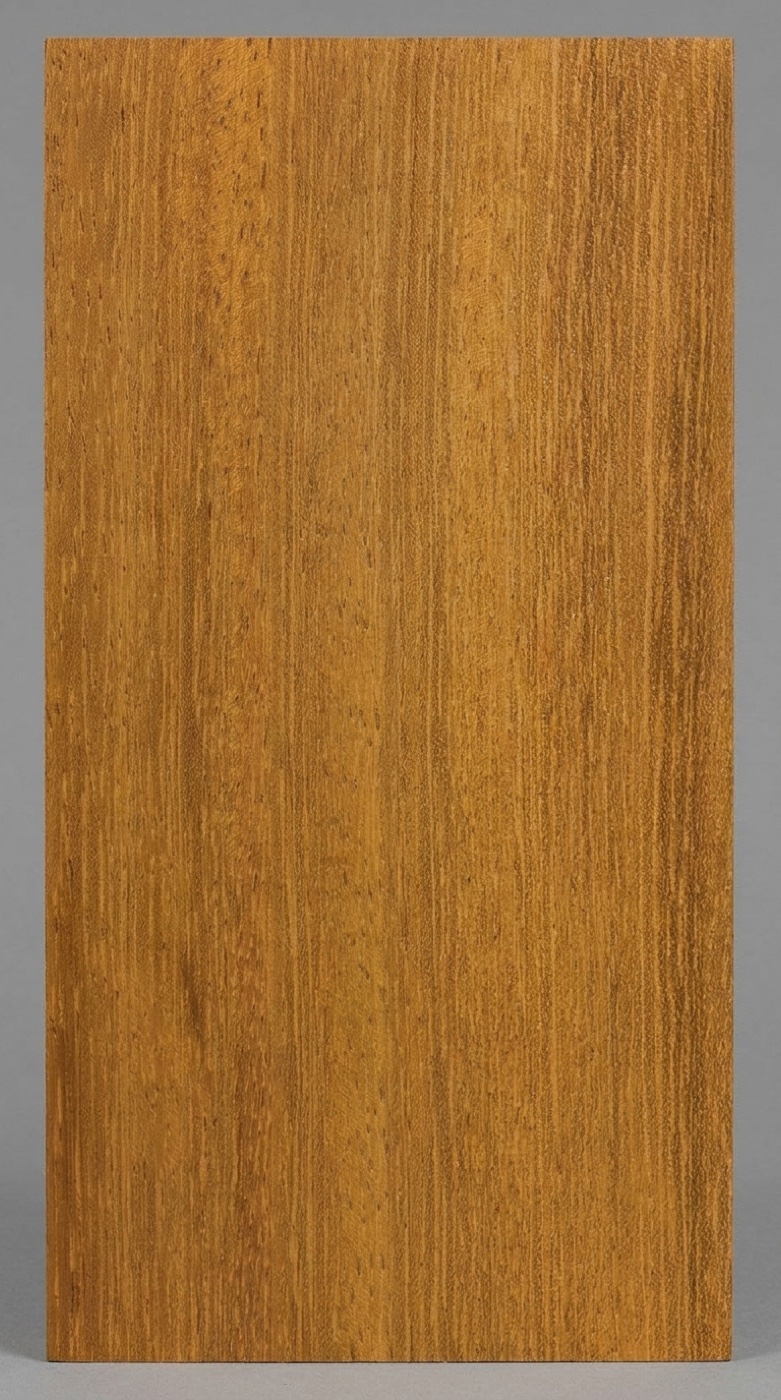
Iroko is yellowish when freshly cut and darkens fairly quickly to a medium golden-to-reddish brown. Left outdoors untreated it weathers to silver-gray, exactly like teak, and many people use it that way deliberately.
Sourcing
Milicia excelsa is IUCN-listed as near threatened and is not CITES-listed. FSC-certified iroko is available and is the sensible thing to ask for.
Typical Uses
Exterior joinery and doors, decking and outdoor furniture, boat building and marine trim, worktops and laboratory benches, flooring, veneer, and turned objects.
Images
Raw Wood: A board of iroko -- golden to reddish brown with interlocked grain and a coarse, open texture