

Wood Species
Olive
Olea europaea
- Janka hardness
- 2700 lbf
- Specific gravity
- 0.98
- Workability
- Turns and polishes magnificently; wildly interlocked grain tears out, and it cracks while drying if you let it
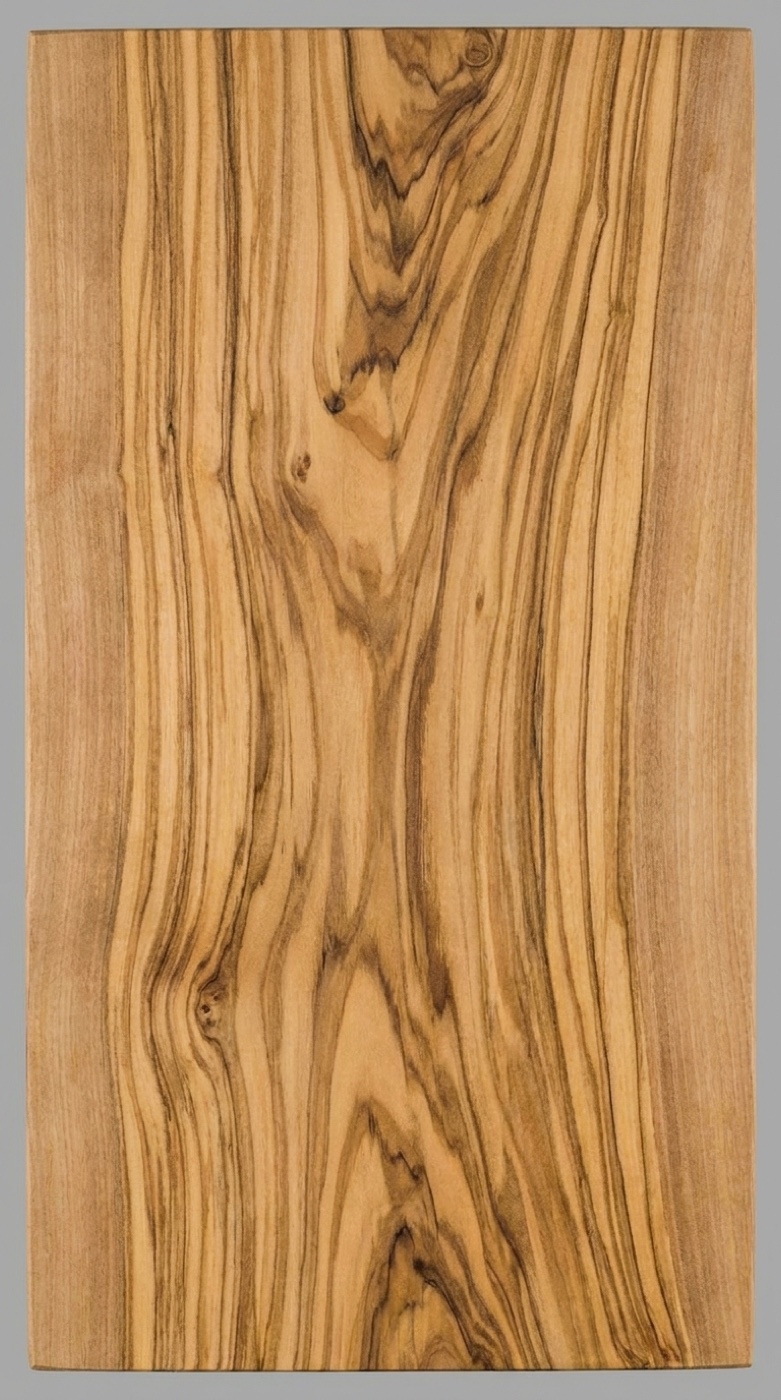
Olive is one of the more visually chaotic woods in trade: a cream-to-yellowish-brown ground crossed by bold, irregular, dark brown and near-black streaks, with grain that swirls and reverses on itself constantly. Two adjacent inches of an olive board rarely look alike.
At 2,700 lbf it's harder than hard maple by a wide margin, dense enough to sink in water, and takes a polish straight off the tool that most woods need three coats of finish to approach.
Where it comes from
Almost entirely from orchard trees at the end of their productive lives, plus wild and ornamental trees, mostly around the Mediterranean and increasingly from California. Olive is not grown for lumber. That has three consequences:
- The pieces are small. Olive trees are short, twisted, heavily branched, and often hollow at the centre. Wide clear boards essentially don't exist.
- It's sold as blanks. Turning blanks, bowl blanks, knife scales, pen blanks, small boards. Buy accordingly.
- It's genuinely a byproduct, which makes it one of the more defensible dense hardwoods to use — nobody fells an olive tree for the wood.
The drying problem
Olive checks and cracks aggressively as it dries. Green olive blanks are common and cheap, and a substantial fraction of them will split before you get to use them. Turners routinely rough-turn green olive to an oversized shape, seal it, let it move, and return it later — which works well and is the standard approach.
For flat work, buy properly dried stock, seal the end grain, acclimate it in your shop, and expect some losses.
Working it
- Very dense and hard on tooling. Carbide, sharp, patient.
- Interlocked, wild grain tears out under any plane, from any direction. Scrapers and abrasives for flat surfaces; for turning, sharp tools and light cuts.
- Oily. Wipe glue joints with acetone before assembly, and use a dewaxed shellac barrier under water-based finishes to avoid curing trouble — see the Finish Simulator.
- Fine, even texture under the chaos, so it finishes glass-smooth without filler.
- Turns beautifully and burnishes to a natural shine. It's a favourite turning wood for good reason.
Olive dust is a known irritant and, for some, a sensitiser. Respirator.
Typical Uses
Turned bowls and objects, kitchenware — boards, utensils, bowls — knife and tool handles, pens, boxes, inlay, small furniture accents, and carving.
Images
Raw Wood: A board of olive -- cream and gold with bold black streaking and wildly swirling grain