

Wood Species
Poplar (Yellow Poplar)
Liriodendron tulipifera
- Janka hardness
- 540 lbf
- Specific gravity
- 0.42
- Workability
- Excellent -- cuts, glues, and takes paint beautifully; too soft to hold a crisp edge and too fuzzy to sand well
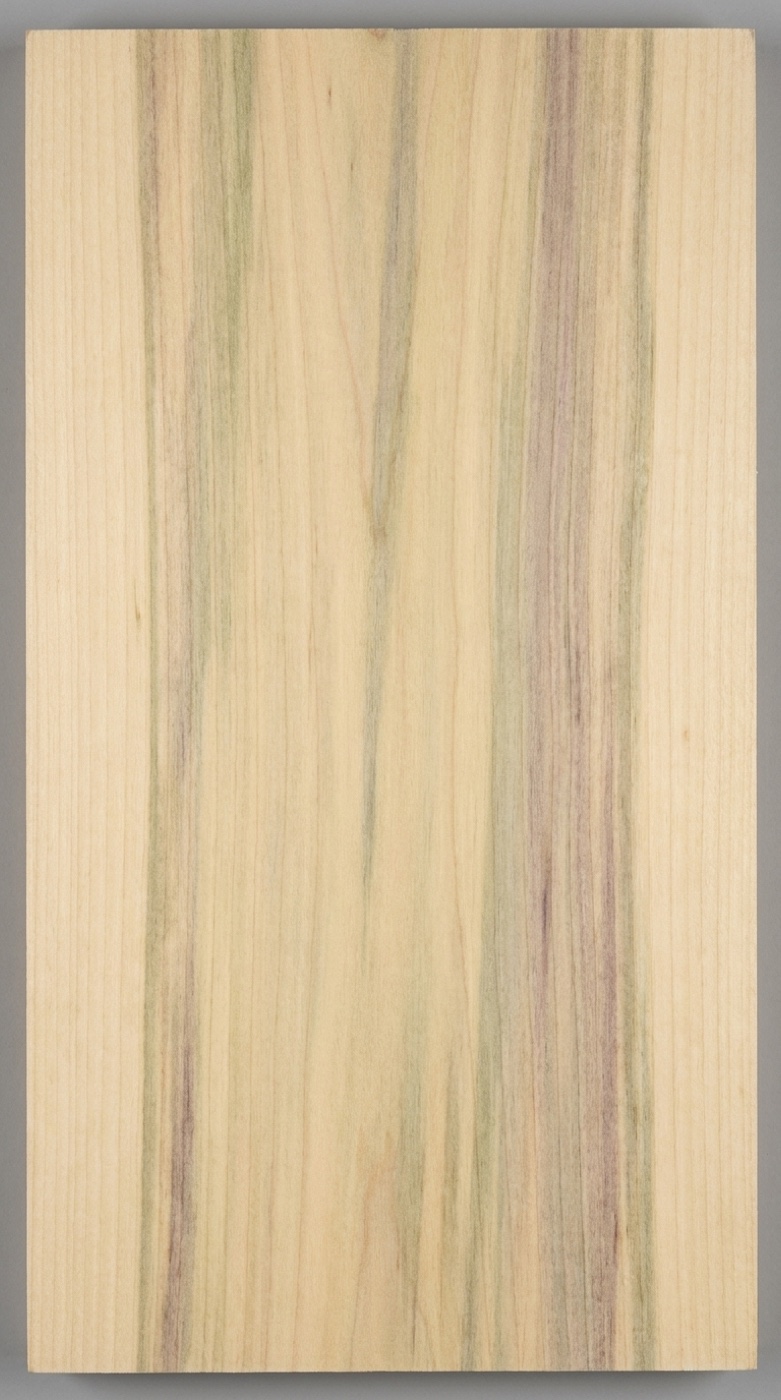
Yellow poplar (Liriodendron tulipifera) — not actually a poplar, but a tulip tree, and not related to the aspens and cottonwoods that share the name — is the cheapest domestic hardwood in North America and one of the most quietly useful woods in any shop. It is also the wood most likely to be dismissed by someone who's never used it properly.
The green streaks
Poplar's most recognizable feature is its color, which is unlike anything else on the rack: creamy white sapwood grading into heartwood that runs olive green, gray, purple, or even black. It looks like the board is bruised. Those streaks are mineral deposits, they're entirely normal, and they will fade toward a dull brown over a year or two of light exposure.
That color is the single biggest thing to plan around. Poplar under a clear finish looks like poplar — green streaks and all — and no amount of stain fixes it, because stain on poplar goes blotchy anyway. Poplar is a paint-grade wood. Accept that and it becomes excellent. Fight it and you'll be disappointed.
Why it's worth buying
At roughly half the price of red oak, and with a hardness between pine and soft maple, poplar hits a genuinely useful spot:
- It machines cleanly on the tablesaw, router, and bandsaw, without the tearout hardwoods with interlocked grain give you.
- It holds a screw and a joint far better than pine, being a real diffuse-porous hardwood, so drawer boxes, cabinet carcases, and jigs built from it stay put.
- It's dimensionally stable and available S4S at nearly every big-box store in useful widths, straight, and reasonably flat.
- It takes paint superbly — closed pores, no grain to fill, no knots bleeding through.
The two real weaknesses
It fuzzes. Poplar's soft fibers tear rather than cut when tooling isn't sharp, leaving a woolly surface that sanding just polishes rather than removes. The fix is sharp tooling and light final passes, plus wiping the surface with a damp rag to raise the fiber and knocking it back before finishing.
It dents. At 540 lbf it's soft for a hardwood — harder than white pine, softer than cherry. It's the wrong choice for a workbench top, a stair tread, or anything that takes daily abuse on a wearing surface.
Typical Uses
Painted furniture and built-ins, cabinet interiors and drawer sides, moulding and trim, upholstery frames, shop jigs, mockups and prototypes, and — historically and still — the secondary wood inside furniture whose show surfaces are something more expensive.
Images
Raw Wood: A board of yellow poplar -- creamy background with the green and gray mineral streaking the species is known for