

Wood Species
Soft Maple (Red Maple)
Acer rubrum
- Janka hardness
- 950 lbf
- Specific gravity
- 0.54
- Workability
- Very good -- easier on tooling than hard maple, and less prone to burning
"Soft maple" is a trade group covering several Acer species — red maple, silver maple, boxelder, bigleaf maple — sold together and distinguished from hard (sugar) maple purely by density. The name does the wood no favors. At 950 lbf Janka it's harder than cherry, harder than walnut, and roughly two and a half times harder than the eastern white pine most people call "soft." It's only soft next to hard maple's 1,450.
Why you'd choose it over hard maple
For most furniture, soft maple is the better pick, and not just on price:
- It's cheaper, often by a third or more.
- It machines more easily and burns less. Hard maple's density makes it notorious for scorching under a router bit or a slow saw feed. Soft maple is far more forgiving.
- It's noticeably lighter in weight, which matters on a big case piece.
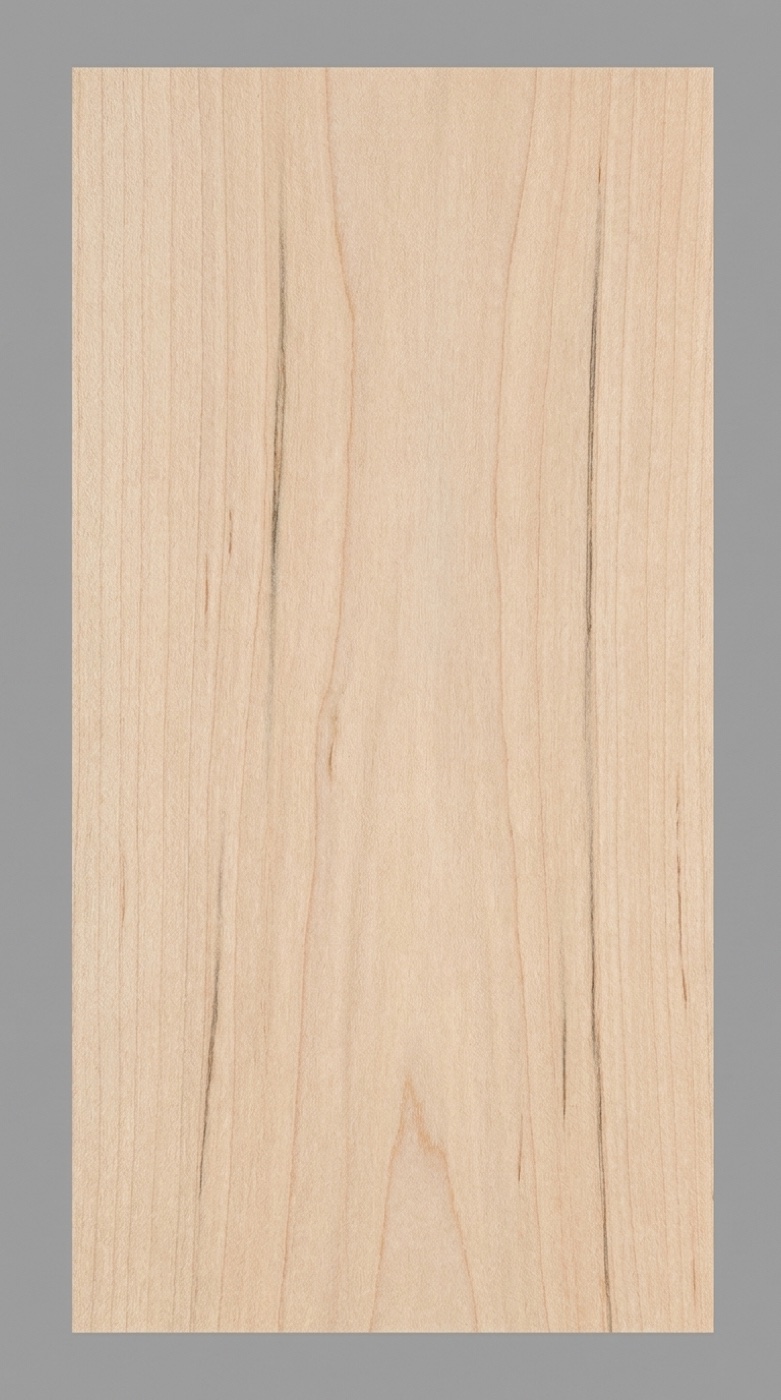
- It looks almost identical once finished — both are pale, fine-textured, and close-grained. Soft maple runs a touch warmer, sometimes with gray-brown mineral streaks.
Hard maple earns its premium in exactly one category: surfaces that get hit. Cutting boards, butcher blocks, workbench tops, bowling lanes, and flooring all genuinely want the extra density. A dresser does not.
The blotching problem
Maple of any kind is one of the worst woods on the rack for staining. Its tight, diffuse-porous structure absorbs pigment unevenly and in patches, so a dark stain applied straight to bare maple looks mottled rather than rich. This isn't a technique failure; it's the wood.
Your options are a dewaxed shellac washcoat or a pre-stain conditioner first, a gel stain that sits on top, or dye rather than pigment stain. Or the honest answer for a wood this pale and even: don't color it at all. The Finish Simulator covers the sequence for each route.
Figure
Soft maple produces curly and quilted figure at least as readily as hard maple — the wildly figured bigleaf maple prized for guitar tops is a soft maple. Figured stock is sold at a substantial premium, tears out badly under a plane, and is worth the trouble.
Typical Uses
Furniture, cabinetry, millwork, veneer, musical instrument bodies and tops, turned work, and pallets — a genuinely enormous range for a wood that gets talked about as an also-ran.
Images
Raw Wood: A board of soft maple -- near-white with a faint warm cast and fine, even, close grain