

Wood Species
Southern Yellow Pine
Pinus taeda, P. palustris, P. echinata, P. elliottii
- Janka hardness
- 690 lbf
- Specific gravity
- 0.57
- Workability
- Machines fine but resin gums up blades and sandpaper; strongly banded grain tears out and blotches
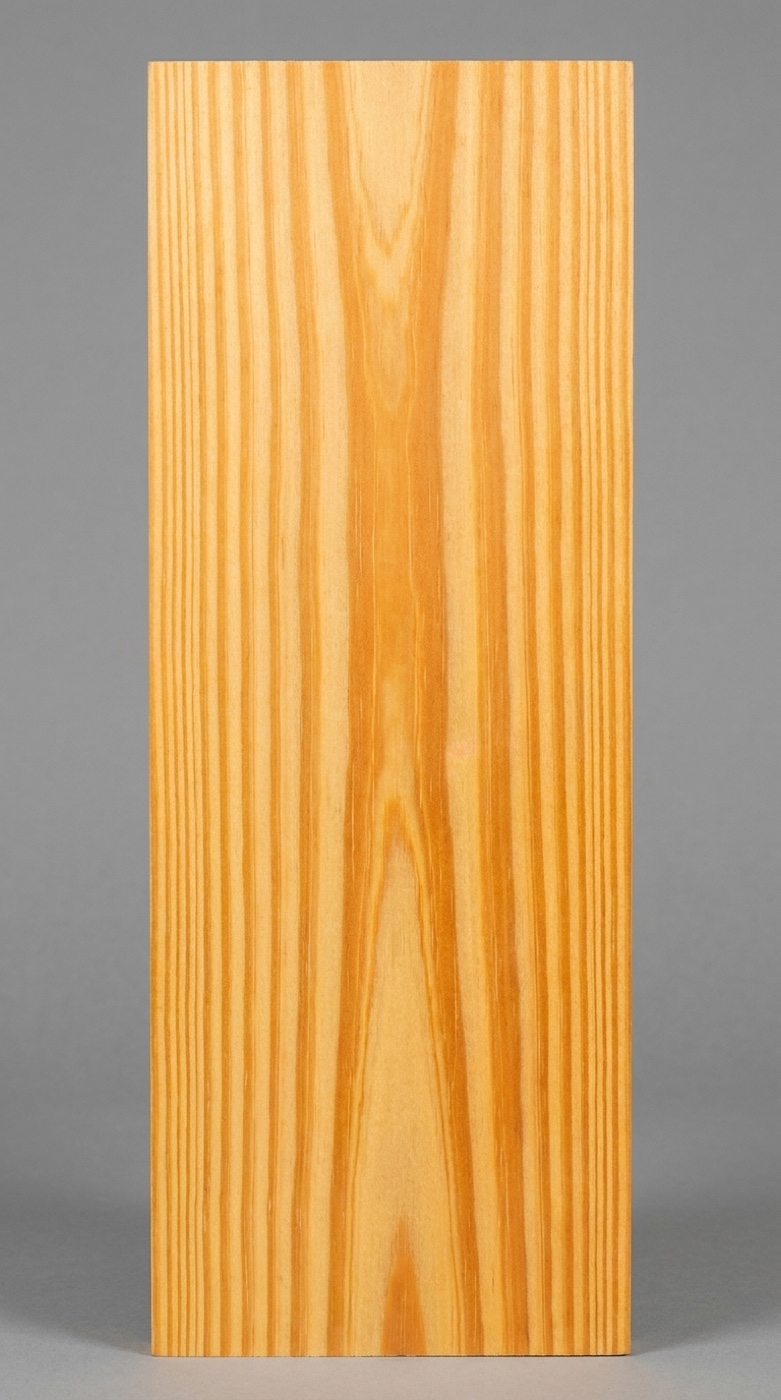
Southern yellow pine isn't one species — it's a commercial group of four fast-growing pines (loblolly, longleaf, shortleaf, and slash) sold interchangeably under one grading stamp. If you're east of the Rockies and buying 2x framing lumber or a pressure-treated deck board, this is very likely what's in your cart, whatever the shelf tag says.
How to tell it apart from white pine
Hold a board of each and the difference is immediate. Southern yellow pine is markedly heavier, distinctly orange-to-amber rather than creamy, and has aggressive, high-contrast growth-ring banding — soft pale earlywood alternating with hard, dark, resinous latewood in stripes you can feel with a fingernail. It also smells strongly of pine resin when cut, in a way white pine doesn't.
At 690 lbf Janka it's roughly twice as dent-resistant as eastern white pine and stiffer in every direction, which is exactly why it's the structural default across the South.
Working Properties
The strength comes with a bill:
- Resin gums everything. Pitch builds up on saw blades, router bits, and sandpaper faster than with almost any other common lumber. Expect to clean blades more often and to load up sanding discs quickly. A blade cleaner and a rubber abrasive cleaning stick are worth owning.
- Banded grain tears out. The hardness swing between earlywood and latewood means planing and routing can lift the soft bands. Take lighter passes and keep tooling genuinely sharp.
- It moves. Construction-grade SYP is often kiln-dried only to 19% moisture content, which is nowhere near stable enough for indoor furniture. Sticker it in your shop for several weeks and let it reach equilibrium before milling, and expect some of it to twist while it does. Then mill it. Skipping this step is why so many 2x4 workbench builds develop a wave in the top.
Finishing
Worse than white pine, for the same reason but more so. That same violent density contrast means pigment stain floods into the soft bands and skates over the hard ones, producing a zebra-striped mess that is very difficult to fix after the fact. A conditioner or shellac washcoat is not optional here if you're staining; gel stain is the safer route; and honestly, clear finish or paint are both better ideas. The Finish Simulator has the full prep sequence.
A note on pressure-treated stock
Most pressure-treated lumber in North America is southern yellow pine, because its cell structure accepts preservative treatment unusually well. Treated stock arrives wet, shrinks substantially as it dries, and carries chemical preservatives — wear a dust mask when cutting it, don't burn the offcuts, and don't use it for anything that touches food or bare skin regularly. It belongs outdoors.
Typical Uses
Framing lumber, joists and trusses, decking, pressure-treated outdoor structures, plywood, flooring, and workbench tops for anyone who's willing to do the drying work first.
Images
Raw Wood: A board of Southern Yellow Pine -- orange-amber with the hard, dark, high-contrast latewood banding that makes it strong and makes it blotch