

Wood Species
SPF / Whitewood (Spruce-Pine-Fir)
Picea, Pinus, and Abies spp.
- Janka hardness
- 480 lbf
- Specific gravity
- 0.4
- Workability
- Easy to cut and fasten; knotty, prone to twist, and wildly inconsistent from board to board
SPF stands for spruce-pine-fir, and it is not a species. It's a North American lumber grading group covering several species across three different genera — white, black, red and Engelmann spruce; lodgepole and jack pine; balsam and subalpine fir — that happen to share close enough strength properties to be graded, stamped, and sold as one interchangeable product. Big-box stores usually shelf-tag it "whitewood."
This is the single most-purchased wood in North America, and the reason it gets its own entry here isn't that it's good. It's that if you don't know what it is, you will keep being confused by it.
Why "which species is this?" has no answer
Every board in the stack is graded on structural performance, not identity. Two studs from the same bundle can be different genera. That's fine for framing a wall — the grade guarantees the strength — and genuinely annoying for anything else, because color, grain, hardness, resin content, and how it takes a finish all vary board to board with no way to sort by it.
If you've ever built two identical projects out of "the same wood" from the same store and had them come out visibly different, this is why.
On spruce specifically
Spruce is worth knowing as its own thing in exactly one context, and it isn't this one. Sitka spruce has the best stiffness-to-weight ratio of any common timber, which is why it's the standard for guitar and piano soundboards and was used for aircraft frames — but that's specialty tonewood stock bought from specialty suppliers, graded and priced on an entirely different basis. You cannot walk into a home center and buy spruce specifically. You buy SPF and get whatever's in it.
Working Properties
- Light, soft, and cheap. Around 480 lbf Janka, splitting the difference between white pine and southern yellow pine. Cuts fast, fastens easily, holds a screw adequately.
- Knotty as a rule. Construction grades allow a lot of knots, including loose ones. Sight down every board in the store — the ten minutes you spend sorting the pile is the highest-value work in the whole project.
- It will move. Framing lumber is dried to around 19% moisture content, not the 6–9% an indoor project wants. It shrinks, cups and twists as it acclimates in a heated shop. Buy it early, sticker it flat with air gaps, and give it a few weeks before you mill it. Nearly every "my 2x4 workbench went out of flat" story starts with skipping this.
- The name lies about the size. A 2x4 is 1 1/2" by 3 1/2". That's the nominal size convention working as designed, not a defect — see Dimensional Lumber for the full table and the reason behind it.
Finishing
Pale, thirsty, and blotch-prone in the usual softwood way, with the added wrinkle that you don't know which species you're finishing, so test pieces from the same board are the only reliable guide. Paint is the honest answer for most SPF projects. If you want it clear, a shellac washcoat first will keep the blotching in check — the Finish Simulator covers the sequence.
What it's actually good for
Framing, shop fixtures, jigs, sawhorses, garage shelving, workbench bases, prototypes, and anything where cost and speed matter more than looks. It is a genuinely excellent material for learning on precisely because ruining a board costs about four dollars. Building a dining table out of it is a different proposition, and the people who do it well are doing a lot of milling and acclimation work first.
Images
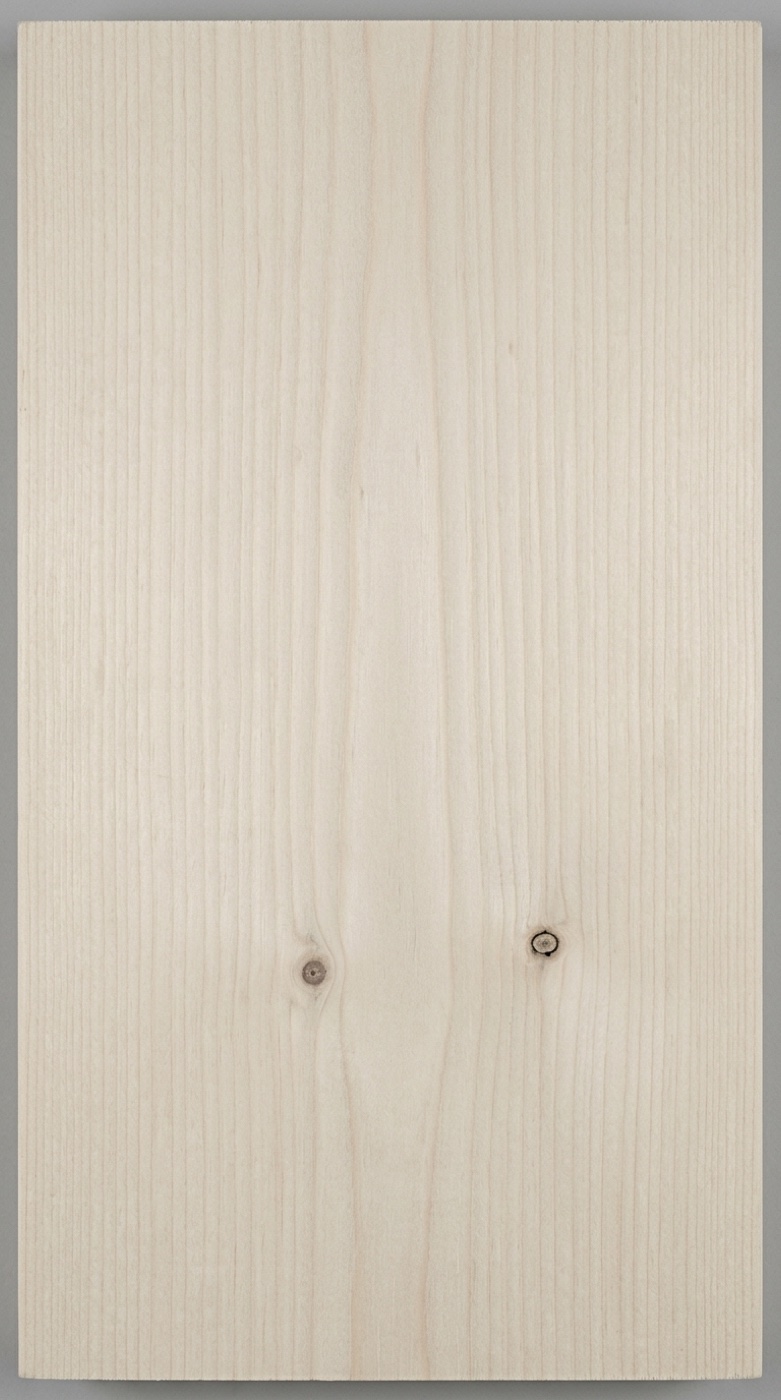
Raw Wood: A board of SPF (whitewood) construction lumber -- very pale and slightly cool-toned, fine close grain, with the tight knots ordinary stud grade allows