

Techniques & Joinery
Dado Joint
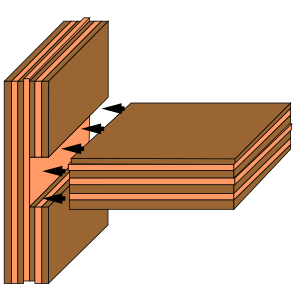
Jim Thomas / Jomegat, CC BY-SA 3.0, via Wikimedia Commons
A dado is a rectangular slot cut across the grain of a board, sized so a second piece fits snugly into it — most commonly a shelf end dropped into a slot cut across a cabinet side. The slot's walls support the shelf along its full depth, not just at a glued surface, which is what makes a dado carry real shelf-load weight without relying on the glue joint to do all the structural work.
How it's different from a groove
The distinction is grain direction, not shape: a dado runs across the grain, a groove runs with the grain. Same cross-section, same tools, different orientation relative to the board — worth knowing because the two terms get used almost interchangeably in casual conversation despite meaning different things.
Cutting the joint
A dado stack on a table saw — a stacked set of blades and chippers that cuts a flat-bottomed slot in one pass at a set width — is the standard shop method for a straight dado across a panel. A router with a straight bit and an edge guide or template is the other common approach, especially useful for a dado that needs to stop partway across the board (a "stopped dado") rather than running the full width.
Fit determines the joint's strength
A dado's structural case depends on the shelf fitting the slot snugly — too loose and the joint relies on glue alone with none of the dado's real advantage; too tight and you're fighting to assemble it, risking a split slot wall. Cut a test dado in scrap with the same setup before committing to the real panel, the same discipline that matters for any joint whose fit is doing the structural work.
Reinforcing it
A dado is already strong on its own for shelf loads, but through-dados (visible on the case's outside edge) are commonly hidden behind a face frame or a strip of edge banding, and long shelves sometimes get a mechanical fastener from underneath in addition to the glued dado for extra insurance against sagging over time — belt-and-suspenders, not a sign the joint alone is inadequate.
Images
Product: Diagram of a dado joint — Jim Thomas / Jomegat, CC BY-SA 3.0, via Wikimedia Commons