

Accessories
Drill Guide Blocks
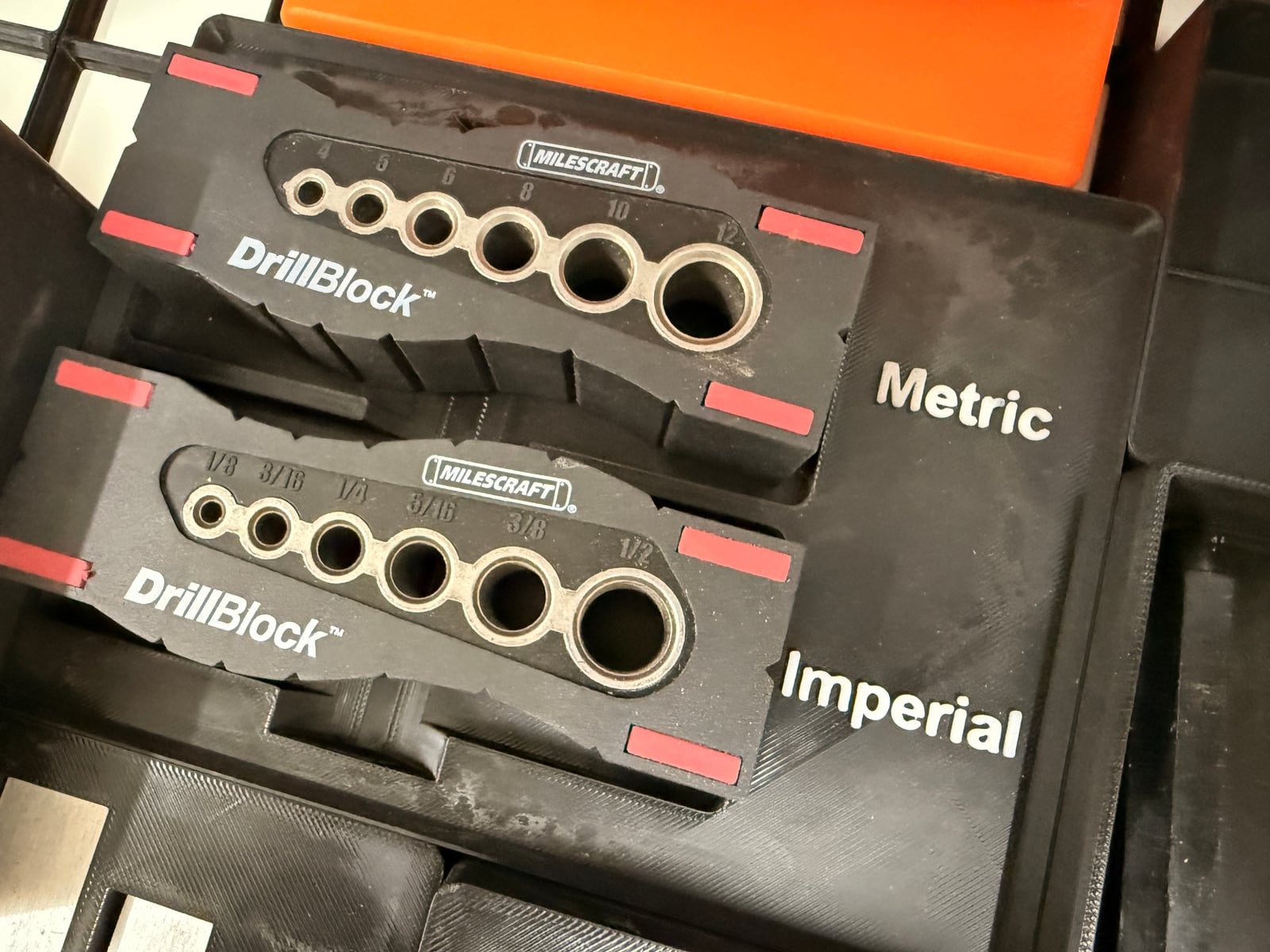
A drill guide block is a block of metal or moulded polymer with hardened bushings running through it at a known angle -- almost always 90 degrees, sometimes with 45 degree options. You hold it against the work, drop the bit down the bushing, and drill. The bushing keeps the bit perpendicular whether or not your hands do.
It exists because drilling square by eye is much harder than it feels. A hole that is two degrees off looks fine going in and is obviously wrong by the time the dowel is seated and the joint will not close.
What it is and is not
A guide block is not a substitute for a drill press. The press is more accurate, repeatable, and can be depth-stopped precisely. What the block does is work where the press cannot: on an assembled carcase, on a board too long to swing, on site, and on the edge of a panel.
The good ones have real hardened steel bushings. The cheap ones drill the guide holes straight into aluminium or plastic, which works for a while and then wallows out into a slightly conical hole that guides nothing. If the bushings are not obviously steel inserts, expect a limited life.
Using one
- Clamp it, or at least brace it hard. The block only guides while it stays put, and a bit grabbing on breakthrough will shift an unclamped block.
- Pick the bushing that matches the bit, not the nearest one. Slop in the bushing is slop in the hole, and it is the one thing the tool exists to eliminate.
- Pair it with a stop collar for depth -- the block controls angle, nothing else.
- Watch for the block riding up on a bit that is packing chips. Peck-drill and clear.
Sets usually come in both imperial and metric because the bushing has to match the bit exactly, and a 3/8in bushing is not a 10mm bushing.
Images
Product: Metric and imperial drill guide blocks, each with hardened steel bushings in a range of sizes.