

Wood Species
Blue Mahoe
Talipariti elatum
- Janka hardness
- 900 lbf
- Specific gravity
- 0.68
- Workability
- Easy to machine and turn for its density; the interlocked grain wants sharp tooling on quartersawn faces
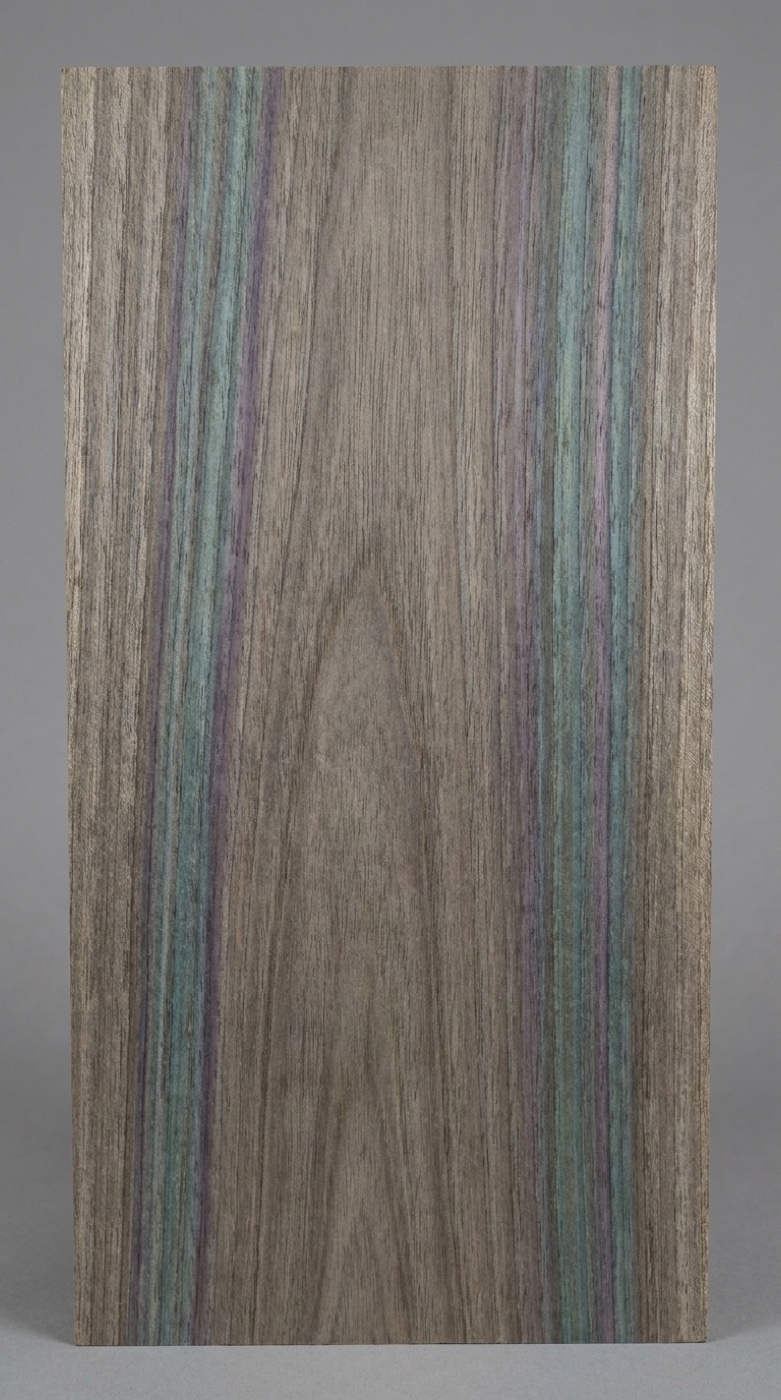
Blue mahoe is the national tree of Jamaica and one of the genuinely strange woods available commercially: its heartwood carries metallic blue-green and purple streaking through an otherwise grayish-brown board. There's nothing else quite like it. Woods described as "blue" are almost always exaggerating; this one isn't.
The colour, honestly
Two qualifications, both important.
It varies enormously. Some boards are dramatically blue-streaked; others are essentially gray-brown with a hint of green and would disappoint anyone who bought on a photo. Buy it in person, or from a seller who photographs the actual board.
It fades. As with nearly every vividly coloured wood, UV exposure pulls it toward a more uniform grayish brown over time. The blue-green is not permanent. A UV-blocking finish and keeping the piece out of direct sun slow it; nothing stops it. Plan for the aged colour, same as with padauk.
Where blue mahoe genuinely shines is in small, indoor, low-light applications — boxes, inlay, jewellery, instrument accents, turned items — where the colour is both the point and reasonably protected.
Working it
Blue mahoe is a hibiscus relative, and it's much easier to work than its 900 lbf and dense feel suggest:
- Machines and turns cleanly, taking detail and a good polish.
- Interlocked grain produces some tearout on quartersawn faces; light passes and sharp edges.
- Fine, even texture, so it finishes smooth without much filler.
- Glues and finishes without the drama oily tropicals bring.
- Only moderately durable — it's an interior wood, not an exterior one.
The bark part
Historically the tree's inner bark was stripped, dried, and used as a natural fibre for tying and weaving — the "mahoe" name traces back through the Caribbean to that use. It's not why anyone buys the lumber, but it explains why a tree with fairly modest timber ended up so widely planted.
Availability
Grown in Jamaica and Cuba and planted for reforestation across the Caribbean, and it's not CITES-listed. Supply to North America is thin and irregular — it's a specialty-supplier wood sold in small pieces, turning blanks, and thin stock rather than by the board foot from a hardwood dealer. Expect to buy it when you see it.
Typical Uses
Boxes and small decorative objects, inlay and marquetry, turning, musical instrument accents, picture frames, furniture accents, and craft work.
Images
Raw Wood: A board of blue mahoe -- gray-brown with the metallic blue-green and purple streaking unique to the species