

Wood Species
Bocote
Cordia spp.
- Janka hardness
- 2010 lbf
- Specific gravity
- 0.86
- Workability
- Machines and turns well for its density; oily enough to need joint prep before glue-up
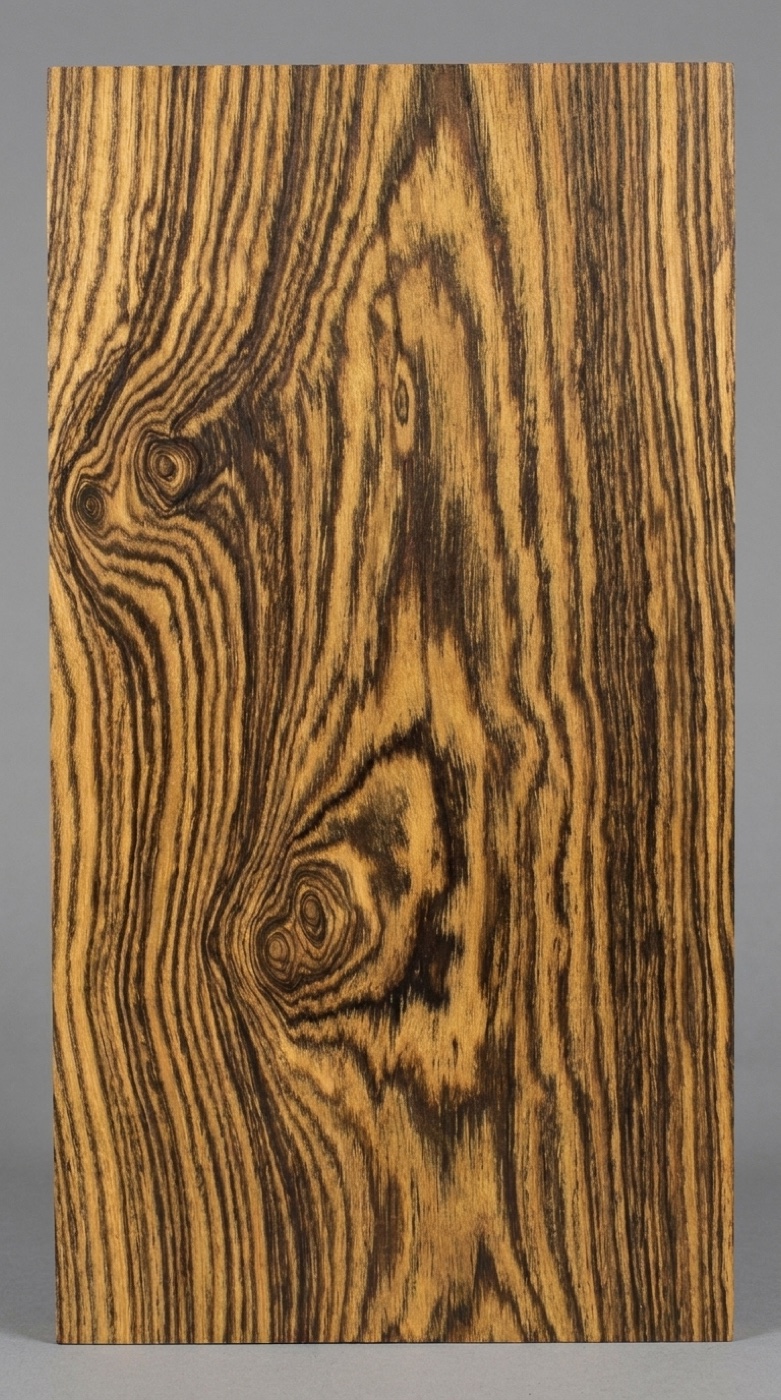
Bocote is a Cordia from Mexico and Central America, and its appeal is entirely visual: a yellowish-tan to golden brown background crossed by bold, irregular, near-black stripes that swirl and loop into eye-shaped patterns. It looks less like grain than like something deliberately drawn on the surface.
That patterning is unpredictable and varies wildly between boards from the same tree, which is part of the appeal and a genuine planning problem — matching two bocote pieces for a symmetrical project means buying more than you need and selecting.
It's related to ziricote
Bocote and ziricote are both Cordia, which explains why they behave similarly on the bench despite looking nothing alike. Ziricote's figure is a dark spiderwebbing over a dark ground; bocote's is dark on light with far more contrast.
Working it
- Dense at 2,010 lbf but noticeably better behaved than most woods in that range. It machines cleanly and takes crisp detail.
- Turns superbly and polishes to a high natural luster with little or no finish — it's a favourite for pens, calls, and small turned work for exactly that reason.
- Oily. Not cocobolo-oily, but enough that glue joints want a solvent wipe (acetone or denatured alcohol) immediately before assembly, and enough that water-based finishes can struggle to cure over it. A dewaxed shellac barrier coat solves both — see the Finish Simulator.
- Stable once dry, with low movement.
- Medium texture with a naturally lustrous surface; it doesn't need much filler.
Bocote dust, like most dense tropicals, is a respiratory irritant. It's not in cocobolo's league as a sensitiser, but a respirator is still the right call.
Buying it
Sold mostly as turning blanks, knife scales, pen blanks, guitar components, and small boards. Wide clear lumber exists but is expensive and usually goes into veneer or instrument work. It isn't CITES-listed.
Note that "bocote" gets applied loosely to several Cordia species with meaningfully different densities and appearances, so what arrives may not exactly match what you last bought under the same name.
Typical Uses
Turned objects and pens, knife handles, musical instruments — particularly guitar backs, sides and fingerboards — veneer, inlay, boxes, gunstocks, and furniture accents.
Images
Raw Wood: A board of bocote -- golden brown with the bold black swirling stripes and eye figure it's bought for