

Wood Species
Ziricote
Cordia dodecandra
- Janka hardness
- 1970 lbf
- Specific gravity
- 0.8
- Workability
- Machines and polishes beautifully; checks and cracks readily during drying, so buy it dry and stable
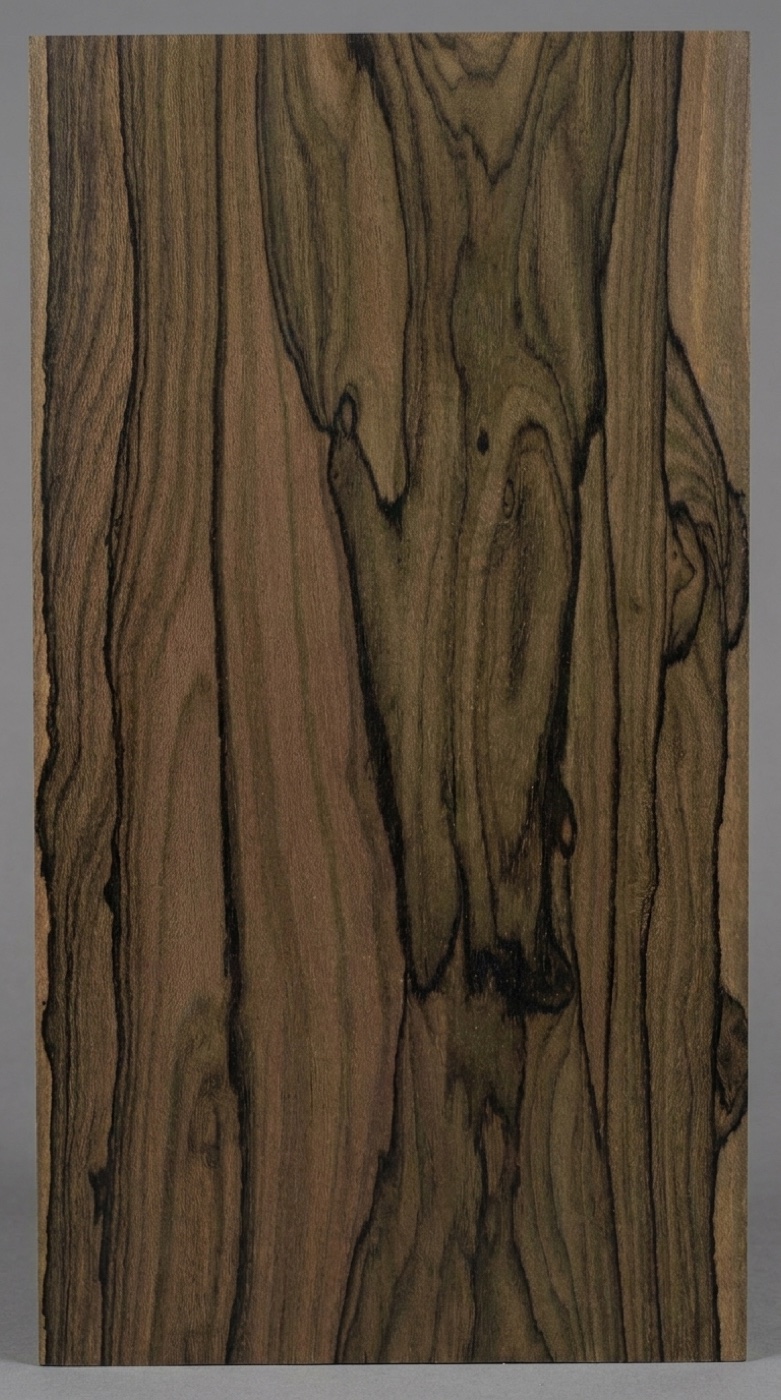
Ziricote is a Cordia from Central America — the same genus as bocote, which explains why they work alike despite looking nothing alike. Ziricote is dark brown to near-black, sometimes with a greenish or purplish cast, crossed by dramatic irregular black streaks that spiderweb across the surface.
Spider webbing and landscape figure
The black streaking is ziricote's signature, and in certain boards it organises itself into what's called landscape or spider-web figure: patterns that genuinely resemble a treeline against a sky. Those boards go to luthiers at prices that make sense only if you've seen one.
Ziricote is one of the premier guitar back-and-side woods, valued for both the look and its tonal properties, and it's used heavily in high-end custom instruments where a rosewood alternative is wanted.
The drying problem
This is the thing that separates a good ziricote purchase from an expensive mistake. Ziricote checks. It has a strong tendency to develop surface and end checks — small cracks — during and after drying, and pieces that seem fine can develop them later with a humidity swing.
Practical consequences:
- Buy it properly dried from a supplier who knows what they're doing, not green or partially seasoned.
- Acclimate it in your shop before working it, and don't rush.
- Inspect carefully. Small checks near an edge are common and workable around; a check running into the middle of a guitar-back-sized piece ruins it.
- Seal end grain if you're storing it any length of time.
Expect some waste. Factor it into what you buy.
Working it
Aside from the checking, ziricote is well behaved for its class:
- Machines cleanly at 1,970 lbf, taking crisp detail.
- Turns and polishes to a superb natural luster with minimal finish.
- Mildly oily — a solvent wipe before glue-up is sensible, and a shellac barrier under water-based finishes avoids curing trouble. See the Finish Simulator.
- Fine, even texture, so it finishes smooth without much grain filler.
Availability
Not CITES-listed, but genuinely scarce — the trees are small, supply is limited, and demand from the instrument world is steady. Sold in guitar sets, turning blanks, knife scales, and small boards. Wide clear lumber is rare and priced accordingly.
Typical Uses
Guitar backs and sides, veneer, turned objects, knife handles, boxes, inlay, and small furniture accents.
Images
Raw Wood: A board of ziricote -- dark brown crossed by the black spiderwebbing streaks that make it a luthier's wood