

Wood Species
Canarywood
Centrolobium spp.
- Janka hardness
- 1520 lbf
- Specific gravity
- 0.78
- Workability
- Very good -- dense but cooperative, machines cleanly, turns well, glues without argument
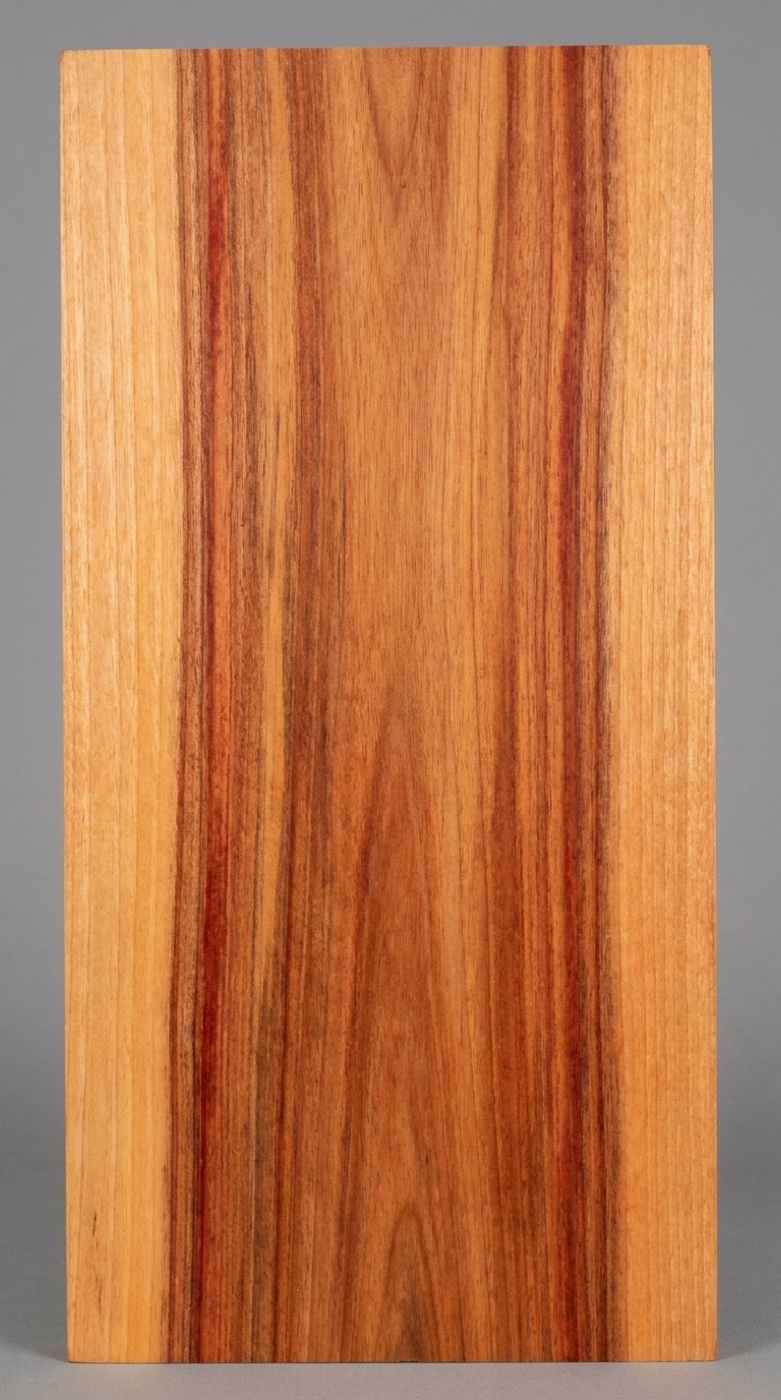
Canarywood is a Centrolobium from South America with an unusual colour range within a single board: pale yellowish orange through to deep reddish brown, streaked with darker red and brown, sometimes shifting dramatically across a few inches. Two boards from the same order can look like different species.
It's one of the better-value dramatic tropicals — visually striking, genuinely pleasant to work, and priced well below the rosewoods and ebonies it sits next to on a supplier's shelf.
The colour shift
Canarywood darkens with UV exposure, but unusually, it darkens toward more contrast rather than away from it — the yellow background ambers while the red streaking deepens, so the pattern generally becomes more pronounced rather than muddier. That's a much friendlier ageing behaviour than padauk's slide to uniform brown, and it's a real reason to prefer it for a piece you want to look good in ten years.
Working it
Canarywood is the rare dense tropical that doesn't punish you:
- Machines cleanly with minimal tearout, despite being 1,520 lbf.
- Turns and polishes beautifully, taking a high natural luster.
- Glues well — it's not notably oily, so no acetone ritual required.
- Finishes without curing problems, unlike the rosewood family.
- Very stable once dry, with low shrinkage and good dimensional behaviour.
- Rot resistant and durable, used for exterior work and boat building in its native range.
Its density is high enough that carbide is the sensible choice and slow feeds will burn it, but neither is unusual for the class.
Availability
Canarywood comes from Brazil and neighbouring countries, isn't CITES-listed, and is reasonably available through specialty hardwood dealers in board, turning-blank, and thin-stock form. It's frequently sold in the same catalogue slot as purpleheart and yellowheart as an accent species.
Typical Uses
Furniture and accents, cabinetry, turned objects, cutting boards, flooring, boat building, veneer, and inlay.
Images
Raw Wood: A board of canarywood -- yellow-orange shifting to reddish brown across the same board, with darker streaks