

Wood Species
Leopardwood
Roupala spp.
- Janka hardness
- 2150 lbf
- Specific gravity
- 0.87
- Workability
- Hard, brittle around the ray flecks, and prone to tearout -- the figure that makes it worth using is the thing making it difficult
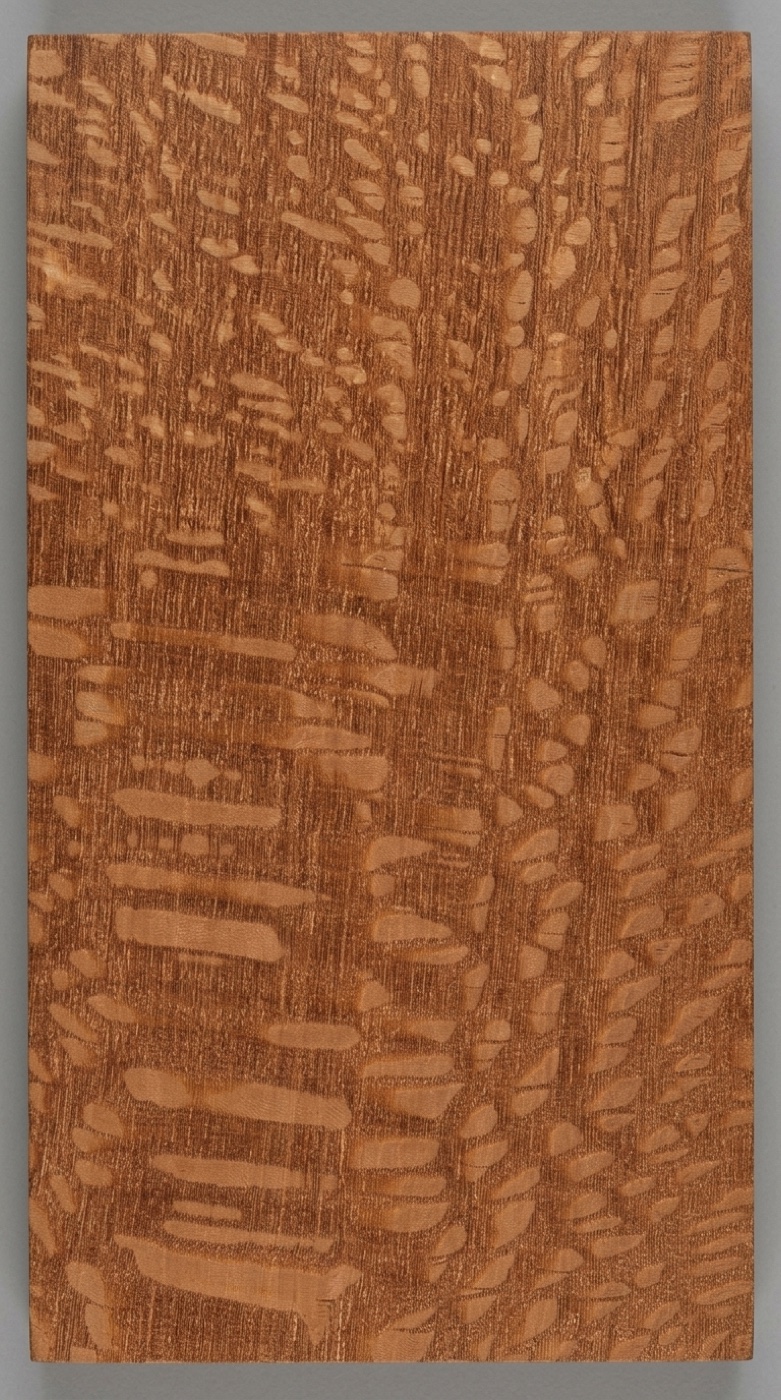
Leopardwood's entire identity is ray fleck — the exposed faces of the sheets of cells running radially through the trunk, which in Roupala are unusually large and closely spaced. Cut across them and the board is covered in a dense, even field of pale, elongated flecks over a reddish brown ground.
Quartersawn or it doesn't exist
This bears emphasising because it catches people out. Ray fleck only appears when the saw passes across the rays, which means quartersawn stock. Plain-sawn leopardwood shows the rays edge-on as short, sparse, uninteresting streaks, and looks like an ordinary reddish-brown board.
If you're buying leopardwood, you are buying quartersawn leopardwood specifically. Check the end grain — the growth rings should run roughly perpendicular to the face.
Leopardwood vs. lacewood
The names get used interchangeably and shouldn't be. Broadly:
- Leopardwood (Roupala) — smaller, denser, more tightly packed flecks; darker reddish-brown ground; heavier and harder.
- Lacewood (usually Panopsis, sometimes Australian silky oak Cardwellia) — larger, more open, lacier flecks; paler ground; lighter and softer.
Both are in the Proteaceae family, both are sold under both names by different suppliers, and the only reliable approach is to look at the actual board.
Notably, quartersawn American sycamore produces a very similar effect at a fraction of the price, and quartersawn white oak produces a bolder, larger version of the same phenomenon.
Working it
The rays are the problem as well as the point:
- Tearout is constant. Ray tissue is structurally different from the surrounding wood and breaks out under a plane or a router. Very light passes, high cutting angles, and expect to finish with a scraper or abrasives.
- It's brittle and chips at edges. Ease everything.
- Hard on tooling at 2,150 lbf; carbide.
- It moves more than most dense tropicals and can be unstable in wide panels — a real consideration for tabletops.
- Coarse texture with visible pores; grain filler for a smooth film finish.
Typical Uses
Veneer, decorative panels and door fronts, furniture accents, boxes, knife handles, turned objects, and musical instruments.
Images
Raw Wood: A quartersawn board of leopardwood -- the dense field of ray flecks that exists only on this cut