

Wood Species
Macassar Ebony
Diospyros celebica
- Janka hardness
- 3220 lbf
- Specific gravity
- 1.12
- Workability
- Harder than Gaboon ebony and just as brittle; interlocked grain tears out and the oils fight glue
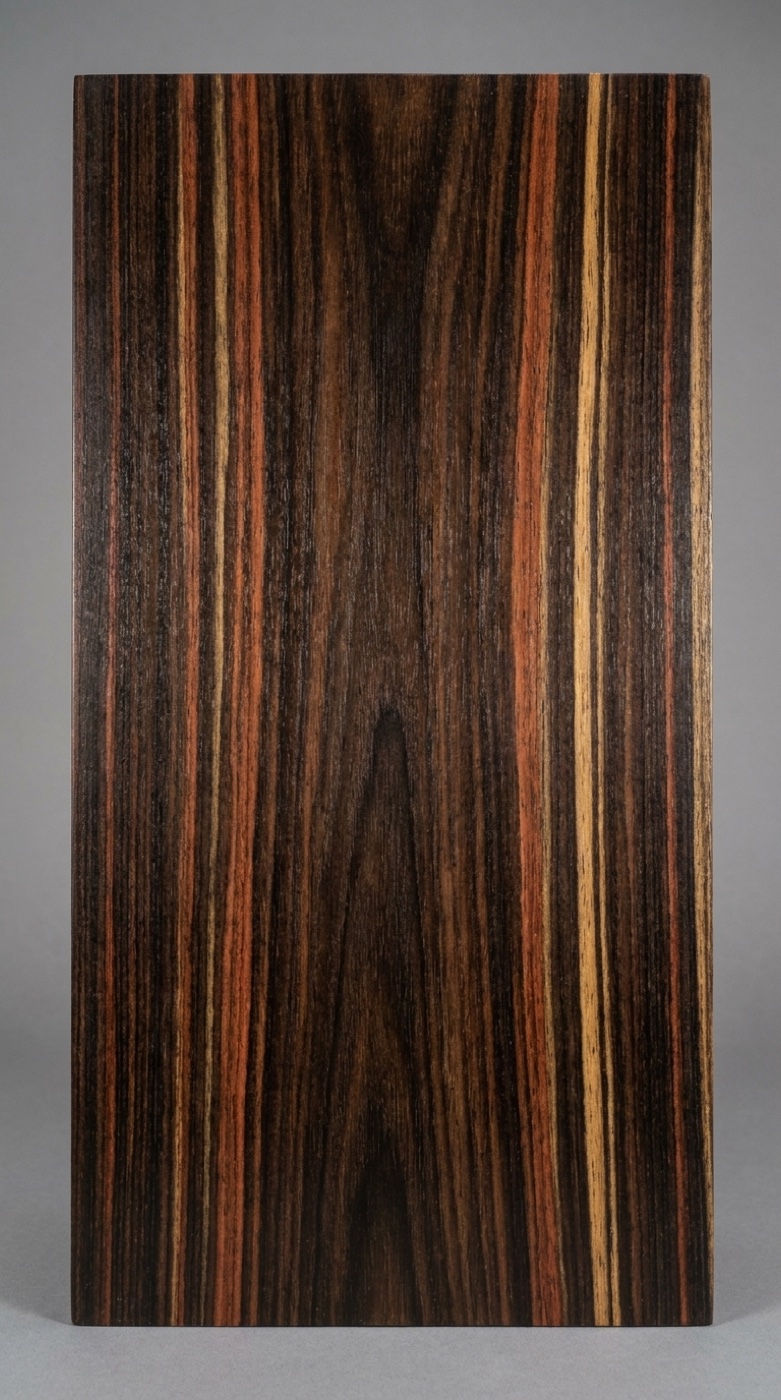
Macassar ebony is a true Diospyros ebony from Indonesia, and where Gaboon ebony is uniformly black, Macassar is boldly striped — dark brown to black bands alternating with lighter reddish and yellowish-tan ones running the length of the board.
That striping made it one of the defining materials of Art Deco furniture and interiors in the 1920s and 30s, where it was used as veneer in bookmatched and radiating patterns that took full advantage of the contrast. It remains a premium decorative veneer and a high-end instrument wood.
Sourcing
Diospyros celebica is IUCN-listed as vulnerable, endemic to Sulawesi, and heavily harvested. As with Gaboon, note the CITES detail precisely: the Appendix II listing for Diospyros covers Madagascan species only, so Macassar ebony is not CITES-controlled and the paperwork won't tell you anything about how it was sourced.
Given that, the honest options are a supplier who can document the chain, or reclaimed and salvaged stock — of which there is a reasonable amount, given how much Art Deco furniture was built from it.
Working it
At 3,220 lbf it is harder than Gaboon ebony and one of the hardest woods in trade:
- It blunts tooling immediately. Carbide and patience.
- Brittle — chips at edges, splits under fasteners without pilot holes.
- Interlocked grain on top of the hardness, so tearout is common. Scrapers and abrasives for final surfaces.
- It checks with humidity swings, as ebonies generally do. Acclimate slowly, seal end grain.
- Oily. Wipe glue joints with acetone before assembly; use a dewaxed shellac barrier under water-based finishes to avoid curing problems. See the Finish Simulator.
- Polishes to a superb natural luster with little or no applied finish.
Ebony dust is an irritant and sensitiser. Respirator, dust collection, the usual.
Veneer vs. solid
Most Macassar ebony in circulation is veneer, and for good reason: it's expensive, it's unstable in solid form at any width, and the figure is best exploited by slicing and matching. If you want the look on a large surface, veneer is the correct answer, not the compromise.
Typical Uses
Decorative veneer and panelling, fine furniture and cabinetry, musical instruments — guitar fingerboards, backs and sides, piano parts — inlay, turned objects, knife handles, and boxes.
Images
Raw Wood: A board of Macassar ebony -- black and gold striping, the figure that defined Art Deco veneer work