

Wood Species
Spanish Cedar
Cedrela odorata
- Janka hardness
- 600 lbf
- Specific gravity
- 0.42
- Workability
- Easy and light, though gum pockets can clog abrasives and the soft fibers fuzz under dull tooling
Spanish cedar is a Cedrela, in the mahogany family Meliaceae, and it is neither Spanish nor a cedar. What it does share with actual cedars is a strong aromatic scent, and that scent is most of its commercial identity.
The humidor wood
Essentially every quality cigar humidor is lined with Spanish cedar, and the reasons are specific rather than traditional:
- It's aromatic in a way that's considered complementary to tobacco rather than competing with it.
- It's exceptionally stable and takes up and gives off moisture readily without warping, which is what a humidity-controlled box needs from its lining.
- Its oils repel insects, including the tobacco beetle.
The same properties make it a standard for chest and drawer linings generally, and for cigar boxes.
Working it
Spanish cedar is essentially mahogany with the density removed: same easy machining, same stability, same open ring-porous grain, at 600 lbf and noticeably lighter in the hand.
- Very easy to cut, plane, and carve. Minimal tearout for a wood with mild interlocking.
- Gum and resin pockets are common and will gum up sandpaper and saw blades. Not a defect so much as a characteristic; expect to clean tooling.
- The soft fibers fuzz under dull edges. Sharp tools, light final passes.
- Naturally rot and insect resistant, which is why it's used for exterior joinery and boat trim in the tropics.
Sourcing
Cedrela odorata is listed on CITES Appendix II, and the IUCN rates it vulnerable. Trade is legal with permits, and plantation-grown stock is increasingly what's available, but it's another wood where asking your supplier where it came from is a reasonable thing to do rather than an imposition.
Finishing
Open-pored — filler if you want a glass-smooth film, though most of its uses don't call for one. Note that the aromatic oils are the point in a humidor or chest interior, so leave interior surfaces unfinished: a film finish seals the scent in and defeats the purpose, exactly as with aromatic red cedar. Exterior surfaces finish like a light mahogany and darken with age.
Typical Uses
Humidors and cigar boxes, drawer and chest linings, guitar necks and classical guitar components, veneer, exterior joinery and millwork, boat trim, and light furniture.
Images
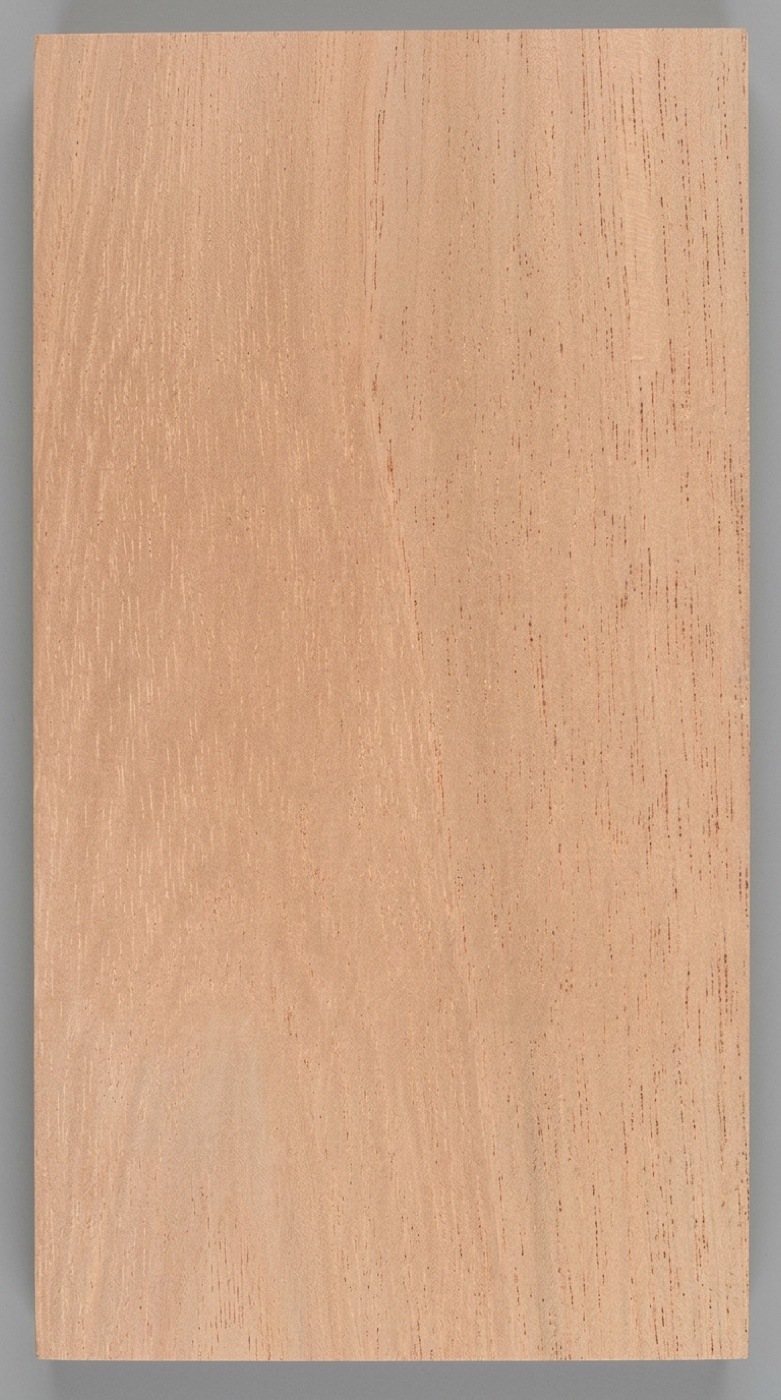
Raw Wood: A board of Spanish cedar -- pale reddish brown, open-pored, and much lighter than the mahogany it's related to