

Wood Species
Honduran Mahogany (Genuine Mahogany)
Swietenia macrophylla
- Janka hardness
- 900 lbf
- Specific gravity
- 0.52
- Workability
- As close to perfect as wood gets -- cuts, carves, glues, and finishes without a single argument
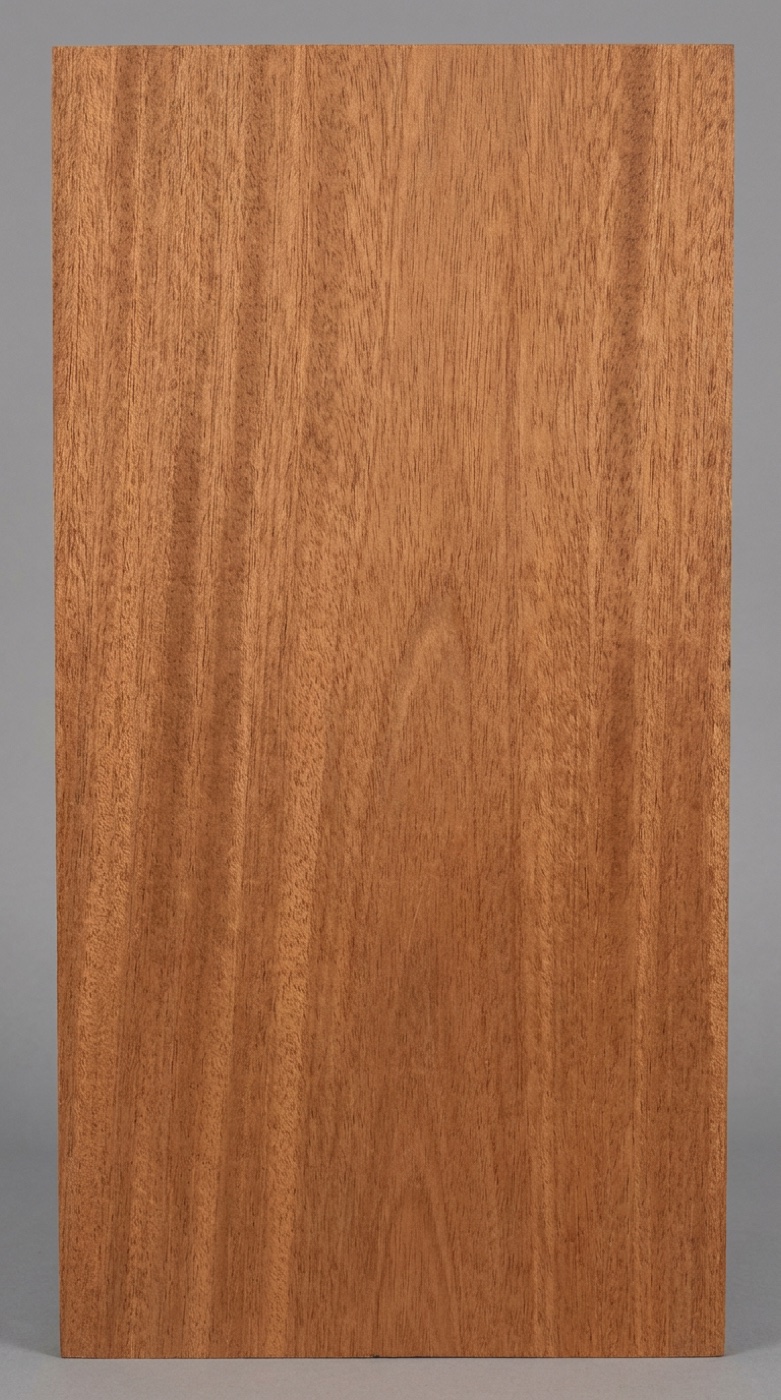
This is the mahogany. Every other wood carrying the name — Philippine, African, Santos, Royal, Chinese — is borrowing it, and most aren't even in the same family. Swietenia macrophylla is what 18th-century cabinetmakers built the Georgian and Federal furniture canon out of, and what the word means when it's used precisely.
Why it earned the reputation
Honduran mahogany is arguably the best-behaved cabinet wood in existence, and the list is genuinely remarkable:
- It's dimensionally stable — very low shrinkage and movement, which is why it was chosen for boat building, pattern making, and anything with wide panels expected to hold their dimensions for a century.
- It machines and carves beautifully with minimal tearout despite mild interlocking, and holds crisp detail.
- It glues, screws, and finishes without complaint.
- It's moderately hard at 900 lbf — enough to be durable furniture, soft enough to be genuinely pleasant to work by hand.
- It's rot resistant.
- It ages gorgeously, deepening from pinkish brown to a rich reddish brown with real depth and chatoyance.
There's a reason it dominated fine furniture for two centuries. Nothing else does all of that at once.
The CITES situation
Swietenia macrophylla has been listed on CITES Appendix II since 2003, meaning international trade requires export permits and documentation. It is not banned — legal, permitted, plantation and managed-forest mahogany is available — but it is regulated, supply is limited, and prices reflect both.
Cuban mahogany (S. mahagoni), the original 18th-century wood, is Appendix II as well and commercially gone.
What this means in practice: buy from a dealer who can document the chain, expect to pay hardwood-specialty prices rather than commodity prices, and be suspicious of anything advertised as "genuine mahogany" at a price that seems too good — it's usually African mahogany, meranti, or something else entirely.
What to use instead
If you want mahogany's working properties without the price or paperwork, the honest substitutes are sapele (harder, more interlocked, ribbon-striped, excellent), African mahogany (closest match, softer, more variable), and Spanish cedar (a relative, lighter and softer, and the traditional choice for humidor and drawer interiors).
Finishing
Open-pored, so a glass-smooth film finish wants grain filler. It takes stain and dye evenly, though most people don't stain it — the natural aged color is the reason to buy it. Oil finishes bring out real depth. See the Finish Simulator.
Typical Uses
Fine furniture, cabinetry, boat building, musical instruments (especially guitar necks and backs), carving, veneer, pattern making, and interior joinery.
Images
Raw Wood: A board of Honduran mahogany -- the deep reddish brown it ages into, with a subtle ribbon stripe