

Wood Species
Yellowheart (Pau Amarello)
Euxylophora paraensis
- Janka hardness
- 1790 lbf
- Specific gravity
- 0.8
- Workability
- Hard and dense but well behaved; occasional interlocked grain tears out and it can burn on a slow feed
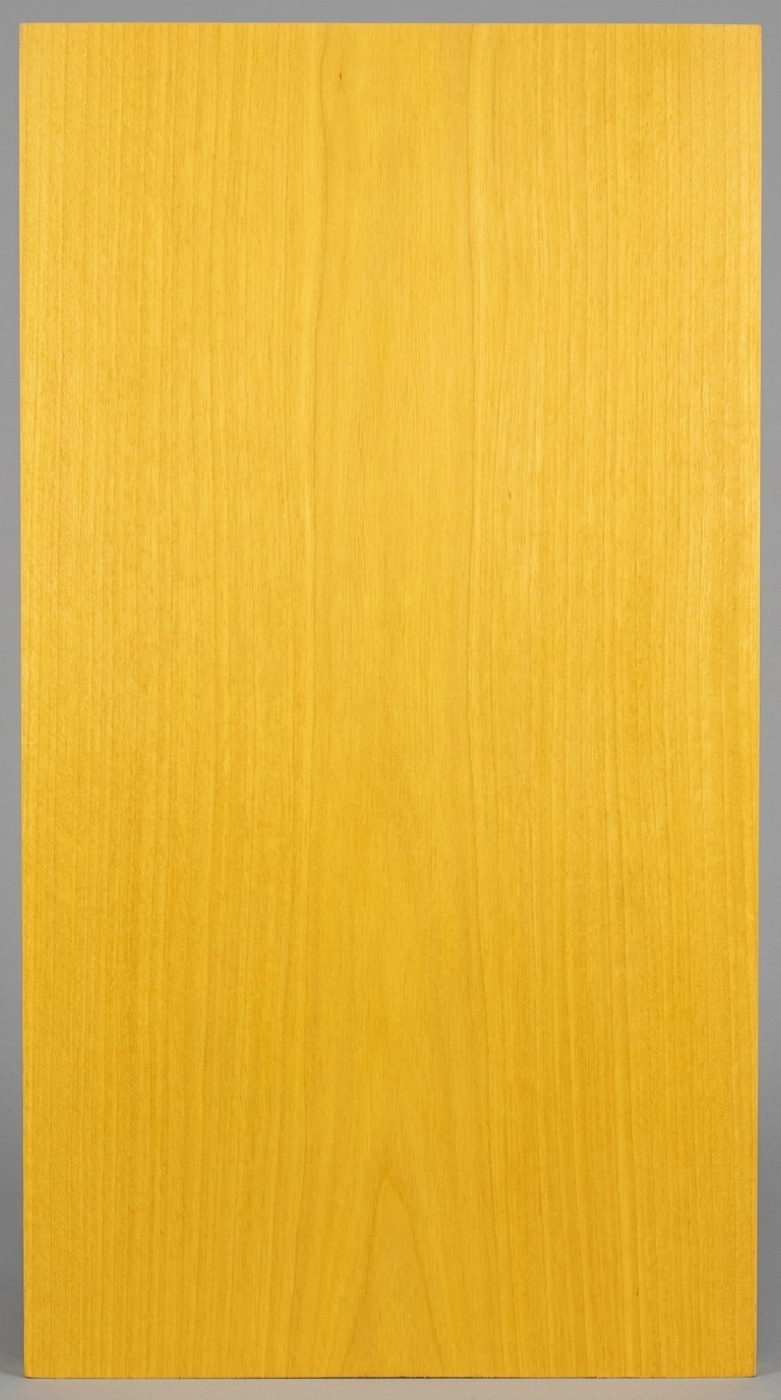
Yellowheart is a bright, clean, saturated lemon-to-golden yellow, remarkably uniform across a board, and it stays that way. That last part is what makes it valuable.
The colourfast one
Most vividly coloured woods are a disappointment waiting to happen. Padauk goes brown. Purpleheart shifts. Osage orange goes from fluorescent yellow to russet. Bloodwood dulls.
Yellowheart is the exception that gets recommended precisely because it doesn't do that. It ambers slightly and deepens a touch toward gold, but it stays recognisably, brightly yellow for the life of the piece. In a species-contrast cutting board or a segmented turning, that reliability is worth more than the initial intensity — a design built on yellowheart still reads the way you drew it after a decade.
The only real competitor for a stable pale yellow is a dyed wood, which brings its own problems.
Working it
- Dense and hard at 1,790 lbf — comparable to hard maple and a bit past it, so expect carbide and reasonable feed rates.
- It burns. Like maple, its density plus a slow feed or a dull bit produces scorch marks that are a nuisance to sand out of a pale wood. Keep moving.
- Mostly straight grained with occasional interlocking that tears out; light passes and a scraper handle it.
- Turns and polishes beautifully, taking a high natural luster.
- Fine, even texture — much closer to closed-grain than most tropicals, so it finishes smooth without grain filler.
Food safety and dust
Yellowheart is widely used for cutting boards and kitchen utensils and there's no specific toxicity concern with the finished wood. The dust, like most tropical hardwood dust, is a respiratory irritant — respirator on, same as always.
One practical note for mixed-species work: yellowheart's fine yellow dust will tint the pores of anything paler sitting next to it in the same glue-up. Sand it after the light woods, not before.
Availability
It comes almost entirely from Brazil, it isn't CITES-listed, and it's reasonably priced for a tropical hardwood — expensive per board foot compared to domestic hardwoods, but you generally buy it in accent-sized quantities rather than by the project.
Typical Uses
Cutting boards and kitchen utensils, inlay and accent strips, segmented and general turning, furniture accents, flooring, boat building, and veneer.
Images
Raw Wood: A board of yellowheart -- clean, saturated, unusually uniform yellow that stays yellow