

Techniques & Joinery
Dowel Joinery
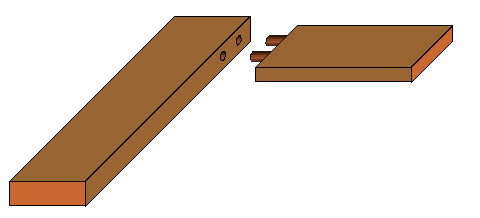
Jim Thomas / Jomegat, CC BY-SA 3.0, via Wikimedia Commons
Dowel joinery joins two pieces with round wooden pins glued into matching holes drilled in each mating piece — a loose-tenon idea that predates power tools by centuries, and still a legitimate, inexpensive way to add real mechanical strength and alignment to a joint that would otherwise be a weak butt joint on its own.
Why it works
Each dowel adds real long-grain glue surface (the round hole's walls bond to the dowel's sides) and resists the joint being pulled or racked apart in a way a flat glued surface can't. Multiple dowels spread across a joint resist twisting too — which is why dowel joints almost always use at least two dowels per connection rather than relying on one to do everything.
The whole method lives or dies on alignment
A dowel joint's entire strength case depends on the holes in both pieces lining up exactly — a hole drilled even slightly off means the dowel pulls the joint out of alignment instead of holding it true, or simply won't seat at all. This is the reason dowel joinery earned a reputation as fussy: doing it accurately by hand with just a drill and a tape measure is genuinely hard. Doweling jigs (self-centering guides that clamp onto the workpiece and index a drill guide to a fixed position) exist specifically to solve this, and are effectively mandatory for consistent results beyond a single joint.
Dowels vs. the alternatives
Compared to biscuit joinery, dowels are stronger and considerably cheaper per joint (a bag of dowel pins costs a fraction of biscuits), but slower to lay out accurately without a jig. Compared to the Festool Domino, dowels are far cheaper in tooling but produce a smaller glue surface per connector, meaning a well-executed Domino joint edges out a dowel joint in raw strength — the practical tradeoff is tool cost against strength and setup speed, not that either method is simply better.
Where it's used
Face-frame assembly, chair and table joinery, and as a budget-friendly substitute anywhere a loose-tenon-style connection is wanted without investing in dedicated joinery tooling. It remains a completely legitimate structural choice, not just a beginner's compromise — plenty of solid, decades-old furniture is held together with nothing more than dowels and glue.
Images
Product: Diagram of a dowel joint — Jim Thomas / Jomegat, CC BY-SA 3.0, via Wikimedia Commons